12. Bob The Vagabond
Bob had on his traveling suit, for a vagabond must go a-journeying. It would never do to stay too long in one place, and here it was August already. Why, he had been in Maine two months and more, and it is small wonder he was getting restless. Restless, though not unhappy! Bob was never that; for the joy of the open way was always before him, and whenever the impulse came, he could set sail and be off.
The meadows of Maine had been his choice for his honeymoon, and a glad time of it he and May had had with their snug little home of woven grass. That home was like an anchor to them both, and held their hearts fast during the days it had taken to make five grown-sized birds out of five eggs. But now that their sons and daughters were strong of wing and fully dressed in traveling suits like their mother's, it was well that Bob had put off his gay wedding clothes and donned a garb of about the same sort as that worn by the rest of his family; for dull colors are much the best for trips.
Now that they were properly dressed, there was nothing left to see to, except to join the Band of Bobolink Vagabonds. Of course no one can be a member of this band without the password; but there was nothing about that to worry Bob. When any of them came near, he called, "Chink," and the gathering flock would sing out a cheery "Chink" in reply: and that is the way he and his family were initiated into the Band of Bobolink Vagabonds. Anyone who can say "Chink" may join this merry company. That is, anyone who can pronounce it with just exactly the right sound!
So, with a flutter of pleasant excitement, they were gone. Off, they were, for a land that lies south of the Amazon, and with no more to say about it than, "Chink."
No trunk, no ticket, no lunch-box; and the land they would seek was four thousand miles or more away! Poor little Bob! had he but tapped at the door of Man with his farewell "Chink," someone could have let him see a map of his journey. For men have printed time-tables of the Bobolink Route, with maps to show what way it lies, and with the different Stations marked where food and rest can be found. The names of some of the most important Stations that a bobolink, starting from Maine, should stop at on the way to Brazil and Paraguay, are Maryland, South Carolina, Florida, Cuba, Jamaica, and Venezuela.
Does it seem a pity that the little ignorant bird started off without knowing even the name of one of these places? Ah, no! A journeying bobolink needs no advice. "Poor," indeed! Why, Bob had a gift that made him fortunate beyond the understanding of men. Nature has dealt generously with Man, to be sure, giving him power to build ships for the sea and the air, and trains for the land, whereon he may go, and power to print time-tables to guide the time of travel. But to Bob also, who could do none of these things, Nature had, nevertheless, been generous, and had given him power to go four thousand miles without losing his way, though he had neither chart nor compass. What it would be like to have this gift, we can hardly even guess--we who get lost in the woods a mile from home, and wander in bewildered circles, not knowing where to turn! We can no more know how Bob found his way than the born-deaf can know the sound of a merry tune, or the born-blind can know the look of a sunset sky. Some people think that, besides the five senses given to a man, Nature gave one more to the bobolink--a sixth gift, called a "sense of direction."
A wonderful gift for a vagabond! To journey hither and yon with never a fear of being lost! To go forty hundred miles and never miss the way! To sail over land and over sea,--over meadow and forest and mountain,--and reach the homeland, far south of the Amazon, at just the right time! To travel by starlight as well as by sunshine, without once mistaking the path!
By starlight? What, Bob, who had frolicked and chuckled through the bright June days, and dozed o' nights so quietly that never a passing owl could see a motion to tempt a chase?
Yes, when he joined the Band of Bobolink Vagabonds, the gates of the night, which had been closed to him by Sleep, were somehow thrown open, and Bob was free to journey, not only where he would, but when he would--neither darkness nor daylight having power to stop him then.
Is it strange that his wings quivered with the joy of voyaging as surely as the sails of a boat tighten in the tugging winds?
What would you give to see this miracle--a bobolink flying through the night? For it has been seen; there being men who go and watch, when their calendars tell them 't is time for birds to take their southward flight. Their eyes are too feeble to see such sights unaided; so they look through a telescope toward the full round moon, and then they can see the birds that pass between them and the light. Like a procession they go--the bobolinks and other migrants, too; for the night sky is filled with travelers when birds fly south.
But though we could not see them, we should know when they are on their way because of their voices. What would you give to hear this miracle--a bobolink calling his watchword through the night? For it has been heard; there being men who go to the hilltops and listen.
As they hear, now and again, wanderers far above them calling, "Chink," one to another, they know the bobolinks are on their way to a land that lies south of the Amazon, and that neither sleep nor darkness bars their path, which is open before them to take when and where they will.
And yet Bob and his comrades did not hasten. The year was long enough for pleasure by the way. He and May had worked busily to bring up a family of five fine sons and daughters early in the summer; and now that their children were able to look out for themselves, there was no reason why the birds should not have some idle, care-free hours.
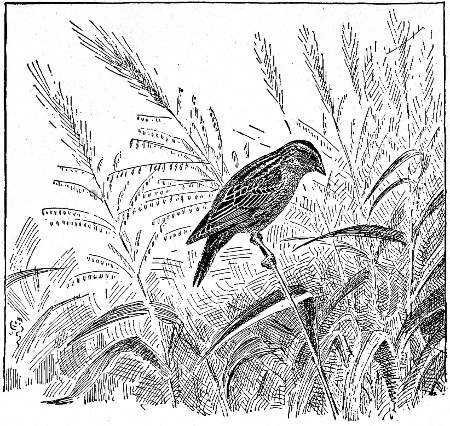 It was time for the Feast of the Vagabonds.
Besides, it was time for the Feast of the Vagabonds, a ceremony that must be performed during the first weeks of the Migrant Flight; for it is a custom of the bobolinks, come down to them through no one knows how many centuries, to hold a farewell feast before leaving North America. If you will glance at a map of the Bobolink Route, you will see the names of the states they passed through. Our travelers did not know these names; but for all that, they found the Great Rice Trail and followed it. They found wild rice in the swamps of Maryland and the neighboring states. In South Carolina they found acres of cultivated rice. For rice is the favorite food during the Feast of the Vagabonds, and to them Nature has a special way of serving it. This same grain is eaten in many lands; taken in one way or another, it is said to be the principal food of about one half of all the people in the world. Bob didn't eat his in soup or pudding or chop-suey. He used neither spoon nor chop-sticks. He took his in the good old-fashioned way of his own folk--unripe, as most of us take our sweet corn, green and in the tender, milky stage, fresh from the stalk. He had been having a rather heavy meat diet in Maine, the meadow insects being abundant, and he relished the change. There was doubtless a good healthy reason for the ceremony of the Feast of the Vagabonds, as anyone who saw Bob may have guessed; for by the time he left South Carolina he was as fat as butter.
In following the Great Rice Trail, Bob went over the same road that he had taken the spring before when he was northward bound; but one could hardly believe him to be the same bird, for he looked different and he acted differently. In the late summer, the departing bird was dull of hue and, except for a few notes that once in a great while escaped him, like some nearly forgotten echo of the spring, he had no more music in him than his mate, May. And when they went southward, they went all together--the fathers and mothers and sons and daughters in one great company.
In the spring it had all been different: Bob had come north with his vagabond brothers a bit ahead of the sister-folk. And the vagabond brothers had been gay of garb--fresh black and white, with a touch of buff. And Bob and his band had been gay of voice. The flock of them had gathered in tree-tops and flooded the day with such mellow, laughing melodies as the world can have only in springtime--and only as long as the bobolinks last.
The ways of the springtime are for the spring, and those of the autumn for the fall of the year. So Bob, who, when northward bound a few months before, had taken part in the grand Festival of Song, now that he was southward bound, partook of the great Feast of the Vagabonds, giving himself whole-heartedly to each ceremony in turn, as a bobolink should, for such are the time-honored customs of his folk.
Honored for how long a time we do not know. Longer than the memory of man has known the rice-fields of South Carolina! Days long before that, when elephants trod upon that ground, did those great beasts hear the spring song of the bobolinks? Is the answer to that question buried in the rocks with the elephants? Bob didn't know. He flew over, with never a thought in his little head but for the Great Rice Trail leading him southward to Florida.
While there, some travelers would have gone about and watched men cut sponges, and have found out why Florida has a Spanish name. But not Bob! The Feast of the Vagabonds, which had lasted well-nigh all the way from Maryland, was still being observed, and even the stupidest person can see that rice is better to eat than sponges or history.
Then, as suddenly as if their "Chink, chink, chink" meant "One, two, three, away we go," the long feast was over, and their great flight again called them to wing their way into the night. How they found Cuba through the darkness, without knowing one star from another; what brought them to an island in the midst of the water that was everywhere alike--no man knows. But in Cuba they landed in good health and spirits. This was in September,--a very satisfactory time for a bird-visit,--and Bob and his comrades spent some little time there, it being October, indeed, when they arrived on the island of Jamaica. Now Jamaica, so people say who know the place, has a comfortable climate and thrilling views; but it didn't satisfy Bob. Not for long! Something south of the Amazon kept calling to him. Something that had called to his father and to his grandfather and to all his ancestors, ever since bobolinks first flew from North America to South America once every year.
How many ages this has been, who knows? Perhaps ever since the icy glaciers left Maine and made a chance for summer meadows there. Long, long, long, it has been, that something south of the Amazon has called to bobolinks and brought them on their way in the fall of the year. So the same impulse quickened Bob's heart that had stirred all his fathers, back through countless seasons. The same quiver for flight came to all the Band of Vagabonds. Was it homesickness? We do not know.
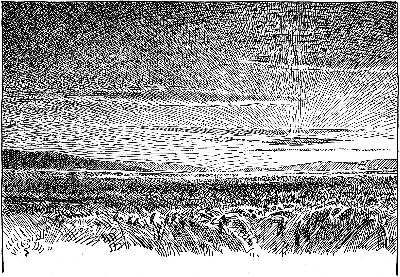 Something south of the Amazon kept calling to him.
We only know that a night came when Bob and his companions left the mountains of Jamaica below them and then behind them. Far, far behind them lay the island, and far, far ahead the coast they sought. Five hundred miles between Jamaica and a chance for rest or food. Five hundred miles; and the night lay about and above them and the waters lay underneath. The stars shone clear, but they knew not one from another. No guide, no pilot, no compass, such as we can understand, gave aid through the hours of their flight. But do you think they were afraid? Afraid of the dark, of the water, of the miles? Listen, in your fancy, and hear them call to one another. "Chink," they say; and though we do not know just what this means, we can tell from the sound that it is not a note of fear. And why fear? There was no storm to buffet them that night. They passed near no dazzling lighthouse, to bewilder them. No danger threatened, and something called them straight and steady on their way.
Oh, they were wonderful, that band! Perhaps among all living creatures of the world there is nothing more wonderful than a bird in his migrant flight--a bird whose blood is fresh with the air he breathes as only a bird can breathe; whose health is strong with the wholesome feast that he takes when and where he finds it; whose wings hold him in perfect flight through unweary miles; whose life is led, we know not how, on, on, on, and ever in the right direction.
Yes, Bob was wonderful when he flew from the mountains of Jamaica to the great savannas of Venezuela; but he made no fuss about it--seemed to feel no special pride. All he said was, "Chink," in the same matter-of-fact way that his bobolink forefathers had spoken, back through all the years when they, too, had taken this same flight over sea in the course of their vagabond journey.
From Venezuela to Paraguay there was no more ocean to cross, and there were frequent places for rest when Bob and his band desired. Groves there were, strange groves--some where Brazil nuts grew, and some where oranges were as common as apples in New England. There were chocolate trees and banana palms. There were pepper bushes, gay as our holly trees at Christmastime. Great flowering trees held out their blossom cups to brilliant hummingbirds hovering by hundreds all about them. Was there one among them with a ruby throat, like that of the hummingbird who feasted in the Cardinal-Flower Path near Peter Piper's home? Maybe 't was the self-same bird--who knows? And let's see--Peter Piper himself would be coming soon, would he not, to teeter and picnic along some pleasant Brazilian shore?
Perhaps Bob and Peter and the hummingbird, who had been summer neighbors in North America, would meet again now and then in that far south country. But I do not think they would know each other if they did. They had all seemed too busy with their own affairs to get acquainted.
Besides the groves where the nuts and fruit and flowers grew, the vagabonds passed over forests so dense and tangled that Bob caught never a glimpse of the monkeys playing there: big brown ones, with heads of hair that looked like wigs, and tiny white ones, timid and gentle, and other kinds, too, all of them being very wise in their wild ways--as wise, perhaps, as a hand-organ monkey, and much, much happier.
No, I don't think Bob saw the monkeys, but he must have caught glimpses of some members of the Parrot Family, for there were so many of them; and I'm sure he heard the racket they made when they talked together. One kind had feathers soft as the blue of a pale hyacinth flower, and a beak strong enough to crush nuts so hard-shelled that a man could not easily crack them with a hammer. But all that was as nothing to Bob. For 't was not grove or forest or beast or bird that the vagabonds were seeking.
When they had crossed the Amazon River, some of the band stopped in places that seemed inviting. But Bob and the rest of the company went on till they crossed the Paraguay River; and there, in the western part of that country, they made themselves at home. A strange, topsy-turvy land it is--as queer in some ways as the Wonderland Alice entered when she went through the Looking-Glass; for in Paraguay January comes in the middle of summer; and the hot, muggy winds blow from the north; and the cool, refreshing breezes come from the south; and some of the wood is so heavy that it will not float in water; and the people make tea with dried holly leaves! But to the Band of Vagabond Bobolinks it was not topsy-turvy, for it was home; and they found the Paraguay prairies as well suited to the comforts of their January summer as the meadows of the North had been for their summer of June.
Bob was satisfied. He had flown four thousand miles from a meadow and had found a prairie! And if, in all that wonderful journey, he had not paid over much attention to anything along the way except swamps and marshes, do not scorn him for that. Remember always that Bob found his prairie and that Peter found his shore.
It is somewhere written, "Seek and ye shall find." 'Tis so with the children of birds--they find what Nature has given them to seek. And is it so with the children of men? Never think that Nature has been less kind to boys and girls than to birds. Unto Bob was given the fields to seek, and he had no other choice. Unto Peter the shores, and that was all. But unto us is given a chance to choose what we will seek. If it is as far away as the prairies of Paraguay, shall we let a dauntless little vagabond put our faith to shame? If it is as near as our next-door meadow, shall we not find a full measure of happiness there--mixed with the bobolink's music of June?
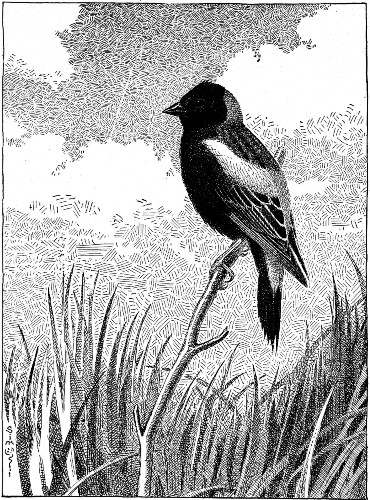 Nature has kept faith with him and brought him safely back to his meadow.
For Bob comes back to the North again, bringing with him springtime melodies, which poets sing about but no human voice can mimic. Bob, who has dusted the dull tips from his feathers as he flew, and who, garbed for the brightness of our June, makes a joyful sound; for Nature has kept faith with him and brought him safely back to his meadow, though the journey from and to it numbered eight thousand miles!
His trail is the open lane of the air,
And the winds, they call him everywhere;
So he wings him North, dear burbling Bob,
With throat aquiver and heart athrob;
And he sings o' joy in the month of June
Enough to keep the year in tune.
Then, when the rollicking young of his kind
Yearn for the paths that the vagabonds find,
He leads them out over loitering ways
Where the Southland beckons with luring days;
To wait till the laughter-like lilt of his song
Is ripe for the North again--missing him long!
Notes
CONSERVATION
We cannot read much nature literature of the present day without coming upon a plea, either implied or expressed, for "conservation." Even the child will wish to know--and there is grave need that he should know--why many people, and societies of people, are trying to save what it has so long been the common custom to waste. Boys and girls living in the Eastern States will be interested to know who is Ornithologist to the Massachusetts State Board of Agriculture, and what his duties are; those in the West will like to know why a publication called "California Fish and Game" should have for its motto, "Conservation of Wild Life through Education"; those between the East and the West will like to learn what is being done in their own states for bird or beast or blossom.
Fortunately the idea is not hard to grasp. Conservation is really but doing unto others as we would that others should do unto us--so living that other life also may have a fair chance. It was a child who wrote, from her understanding heart:--
"When I do have hungry feels I feel the hungry feels the birds must be having. So I do have comes to tie things on the trees for them. Some have likes for different things. Little gray one of the black cap has likes for suet. And other folks has likes for other things."--From The Story of Opal.
CHICK, D.D.
Penthestes atricapillus is the name men have given the bird who calls himself the "Chickadee."
The Bird (Beebe), page 186. "The next time you see a wee chickadee, calling contentedly and happily while the air makes you shiver from head to foot, think of the hard-shelled frozen insects passing down his throat, the icy air entering lungs and air-sacs, and ponder a moment on the wondrous little laboratory concealed in his mite of a body, which his wings bear up with so little effort, which his tiny legs support, now hopping along a branch, now suspended from some wormy twig.
"Can we do aught but silently marvel at this alchemy? A little bundle of muscle and blood, which in this freezing weather can transmute frozen beetles and zero air into a happy, cheery little Black-capped Chickadee, as he names himself, whose trustfulness warms our hearts!
"And the next time you raise your gun to needlessly take a feathered life, think of the marvellous little engine which your lead will stifle forever; lower your weapon and look into the clear bright eyes of the bird whose body equals yours in physical perfection, and whose tiny brain can generate a sympathy, a love for its mate, which in sincerity and unselfishness suffers little when compared with human affection."
Bird Studies with a Camera (Chapman), pages 47-61.
Handbook of Nature-Study (Comstock), pages 66-68.
Nature Songs and Stories (Creighton), pages 3-5.
American Birds (Finley), pages 15-22.
Winter (Sharp), chapter VI.
Educational Leaflet No. 61. (National Association of Audubon Societies.)
This story was first published in the Progressive Teacher, December, 1920.
THE FIVE WORLDS OF LARIE
Larus argentatus, the Herring Gull.
Larie's "policeman," like Ardea's "soldier," is usually called a "warden." No thoughtful or informed person can look upon "bird study" as merely a pleasant pastime for children and a harmless fad for the outdoor man and woman. It is a matter that touches, not only the æsthetic, but the economic welfare of the country: a matter that has concern for legislators and presidents as well as for naturalists. In this connection it is helpful to read some such discussion as is given in the first four references.
Bird Study Book (Pearson), pages 101-213; 200.
Birds in their Relation to Man (Weed and Dearborn), pages 255-330.
Bird-Lore, vol. 22, pages 376-380.
Useful Birds and their Protection (Forbush), pages 354-421.
Birds of Ohio (Dawson), pages 548-551; "Herring Gull."
Bird Book (Eckstorm), pages 23-29; "The Herring Gull."
American Birds (Finley), pages 211-217; "Gull Habits."
Game-Laws for 1920 (Lawyer and Earnshaw), pages 68-75; "Migratory-Bird Treaty Act."
Tales from Birdland (Pearson), pages 3-27; "Hardheart, the Gull."
Educational Leaflet No. 29; "The Herring Gull." (National Association of Audubon Societies.)
PETER PIPER
Actitis macularia, the Spotted Sandpiper.
Educational Leaflet No. 51. (National Association of Audubon Societies.)
"A leisurely little flight to Brazil."
Peter, the gypsy, and Bob, the vagabond, are both famous travelers, and might have passed each other on the way, coming and going, in Venezuela and in Brazil. Peter, like Bob, is a night migrant, stopping in the daytime for rest and food.
For references to literature on bird-migration, the list under the notes to "Bob, the Vagabond," may be used.
GAVIA OF IMMER LAKE
Gavia immer, the Loon.
The Bird (Beebe). "Hesperornis--a wingless, toothed, diving bird, about 5 feet in length, which inhabited the great seas during the Cretaceous period, some four millions of years ago." (Legend under colored frontispiece.)
Life Histories of North American Diving Birds (Bent), pages 47-60.
Bird Book (Eckstorm), pages 9-13.
By-Ways and Bird-Notes (Thompson), pages 170-71. "The cretaceous birds of America all appear to be aquatic, and comprise some eight or a dozen genera, and many species. Professor Marsh and others have found in Kansas a large number of most interesting fossil birds, one of them, a gigantic loon-like creature, six feet in length from beak to toe, taken from the yellow chalk of the Smoky Hill River region and from calcareous shale near Fort Wallace, is named Hesperornis regalis."
Educational Leaflet No. 78. (National Association of Audubon Societies.)
If twenty years of undisputed possession seems long enough to give a man a legal title to "his" land, surely birds have a claim too ancient to be ignored by modern beings. Are we not in honor bound to share what we have so recently considered "ours," with the creatures that inherited the earth before the coming of their worst enemy, Civilization? And in so far as lies within our power, shall we not protect the free, wild feathered folk from ourselves?
EVE AND PETRO
Petrochelidon lunifrons, Cliff-Swallow, Eave-Swallow.
Bird Studies with a Camera (Chapman), pages 89-105; "Where Swallows Roost."
Handbook of Nature-Study (Comstock), pages 112-113.
Bird Migration (Cooke), pages 5, 9, 19-20, 26, 27; Fig. 6.
Our Greatest Travelers (Cooke), page 349; "Migration Route of the Cliff Swallows."
Bird Book (Eckstorm), pages 201-12.
Bird-Lore, vol. 21, page 175; "Helping Barn and Cliff Swallows to Nest."
UNCLE SAM
Haliæetus leucocephalus, the Bald Eagle.
Stories of Bird Life (Pearson), pages 71-80; "A Pair of Eagles."
The Fall of the Year (Sharp), chapter V.
Educational Leaflet No. 82. (National Association of Audubon Societies.)
At the time this story goes to press, our national emblem is threatened with extermination. The following references indicate the situation in 1920:--
Conservationist, The, vol. 3, pages 60-61; "Our National Emblem."
National Geographic Magazine, vol. 38, page 466.
Natural History, vol. 20, pages 259 and 334; "The Dead Eagles of Alaska now number 8356."
Science, vol. 50, pages 81-84; "Zoölogical Aims and Opportunities," by Willard G. Van Name.
CORBIE Corvus brachyrhynchos, the Crow.
The Bird (Beebe), pages 153, 158, 172, 200-01, 209. "When the brain of a bird is compared with that of a mammal, there is seen to be a conspicuous difference, since the outer surface is perfectly smooth in birds, but is wound about in convolutions in the higher four-footed animals. This latter condition is said to indicate a greater degree of intelligence; but when we look at the brain of a young musk-ox or walrus, and find convolutions as deep as those of a five-year-old child, and when we compare the wonderfully varied life of birds, and realize what resource and intelligence they frequently display in adapting themselves to new or untried conditions, a smooth brain does not seem such an inferior organ as is often inferred by writers on the subject. I would willingly match a crow against a walrus any day in a test of intelligent behavior.... A crow ... though with horny, shapeless lips, nose, and mouth, looks at us through eyes so expressive, so human, that no wonder man's love has gone out to feathered creatures throughout all his life on the earth."
Handbook of Nature-Study (Comstock), pages 129-32.
American Birds (Finley), pages 69-77; "Jack Crow."
The Crow and its Relation to Man (Kalmbach).
Outdoor Studies (Needham), pages 47-53; "Not so Black as he is Painted."
Tales from Birdland (Pearson), pages 128-52; "Jim Crow of Cow Heaven."
Our Backdoor Neighbors (Pellett), pages 181-98; "A Jolly Old Crow."
Our Birds and their Nestlings (Walker), pages 76-85; "The Children of a Crow."
The Story of Opal (Whiteley); "Lars Porsena."
Gray Lady and the Birds (Wright), pages 114-28.
Bird Lore, vol. 22 (1919), pages 203-04; "A Nation-Wide Effort to Destroy Crows."
Educational Leaflet No. 77. (National Association of Audubon Societies.)
ARDEA'S SOLDIER
Ardea's scientific name used to be Ardea candidissima, and the older references to this bird will be found under that name, though at present it is known as Egretta candidissima. It is commonly called the Snowy Egret, or the Snowy Heron. The other white heron wearing "aigrettes" is Herodias egretta. Ardea's "soldier," like Larie's "policeman," is usually spoken of as a "warden." With reference to this story there is much of interest in the following:--
Bird Study Book (Pearson), pages 140-66, "The Traffic in Feathers"; pages 167-89, "Bird Protection Laws"; pages 190-213, "Bird Reservations": pages 244-58, "Junior Audubon Classes."
Stories of Bird Life (Pearson), pages 153-60; "Levy, the Story of an Egret."
Birds in their Relation to Man (Weed and Dearborn), pages 237-38.
Gray Lady and the Birds (Wright), pages 67-80; "Feathers and Hats."
Educational Leaflets Nos. 54 and 54A; "The Egret" and "The Snowy Egret." (National Association of Audubon Societies.)
To Mr. T. Gilbert Pearson, who has visited more egret colonies than any other person in the country, and who, in leading fights for their protection, has kept in very close touch with the egret situation, an expression of indebtedness and appreciation is due for his kindness in reading "Ardea's Soldier" while yet in manuscript, and for certain suggestions with reference to the story.
THE FLYING CLOWN
Chordeiles virginianus, the Nighthawk or Bull-bat.
Bird Migration (Cooke), pages 5, 7, 9.
Nature Sketches in Temperate America (Hancock), pages 246-48.
Birds in their Relation to Man (Weed and Dearborn), pages 178-80.
Bird-Lore, vol. 20 (1918), page 285.
Educational Leaflet No. 1. (National Association of Audubon Societies.)
THE LOST DOVE
Ectopistes migratorius, the Passenger Pigeon.
"How can a billion doves be lost?"
History of North American Birds (Baird, Brewer and Ridgway), vol. 3, pages 368-74.
Michigan Bird Life (Barrows), pages 238-51.
Birds that Hunt and are Hunted (Blanchan), pages 294-96.
Travels of Birds (Chapman), pages 73-74.
Birds of Ohio (Dawson and Jones), pages 425-27.
Passenger Pigeon (Mershon).
Natural History of the Farm (Needham), pages 114-15. "The wild pigeon was the first of our fine game birds to disappear. Its social habits were its undoing, when once guns were brought to its pursuit. It flew in great flocks, which were conspicuous and noisy, and which the hunter could follow by eye and ear, and mow down with shot at every resting-place. One generation of Americans found pigeons in 'inexhaustible supply'; the next saw them vanish--vanish so quickly, that few museums even sought to keep specimens of their skins or their nests or their eggs; the third generation (which we represent) marvels at the true tales of their aforetime abundance, and at the swiftness of their passing; and it allows the process of extermination to go on only a little more slowly with other fine native species."
Bird Study Book (Pearson), pages 128-29. "Passenger Pigeons as late as 1870 were frequently seen in enormous flocks. Their numbers during the periods of migration were one of the greatest ornithological wonders of the world. Now the birds are gone. What is supposed to have been the last one died in captivity in the Zoölogical Park of Cincinnati, at 2 P.M. on the afternoon of September 1, 1914. Despite the generally accepted statement that these birds succumbed to the guns, snares, and nets of hunters, there is a second cause, which doubtless had its effect in hastening the disappearance of the species. The cutting away of vast forests, where the birds were accustomed to gather and feed on mast, greatly restricted their feeding range. They collected in enormous colonies for the purpose of rearing their young; and after the forests of the Northern states were so largely destroyed, the birds seem to have been driven far up into Canada, quite beyond their usual breeding range. Here, as Forbush suggests, the summer probably was not sufficiently long to enable them to rear their young successfully."
Birds in their Relation to Man (Weed and Dearborn), pages 219-22.
Educational Leaflet No. 6. (National Association of Audubon Societies.) "Those who study with care the history of the extermination of the Pigeons will see, however, that all the theories brought forward to account for the destruction of the birds by other causes than man's agency are wholly inadequate. There was but one cause for the diminution of the birds, which was widespread, annual, perennial, continuous, and enormously destructive--their persecution by mankind. Every great nesting-ground was besieged by a host of people as soon as it was discovered, many of them professional pigeoners, armed with all the most effective engines of slaughter known. Many times the birds were so persecuted that they finally left their young to the mercies of the pigeoners; and even when they remained, most of the young were killed and sent to the market, and the hosts of the adults were decimated."
LITTLE SOLOMON OTUS
Otus asio, the Screech Owl, are the scientific and common names of our little friend Solomon. Perhaps the fact that owls stand upright and gaze at one with both eyes to the front, accounts in part for their looking so wise that they have been used as a symbol of wisdom for many centuries.
In the Library of Congress in Washington, there is a picture called "The Boy of Winander." When looking at this, or some copy of it, it is pleasant to remember the lines of Wordsworth's poem:--
There was a Boy; ye knew him well, ye cliffs
And islands of Winander!--many a time,
At evening, when the earliest stars began
To move along the edges of the hills,
Rising or setting, would he stand alone,
Beneath the trees, or by the glimmering lake;
And there, with fingers interwoven, both hands
Pressed closely palm to palm and to his mouth
Uplifted, he, as through an instrument,
Blew music hootings to the silent owls,
That they might answer him.
Following are a few references to Screech Owls:--
Handbook of Nature-Study (Comstock), pages 104-07.
Some Common Game, Aquatic and Rapacious Birds (McAtee and Beal), pages 27-28.
Our Backdoor Neighbors (Pellet), pages 63-74; "The Neighborly Screech Owls."
My Pets (Saunders), pages 11-33.
Birds in their Relation to Man (Weed and Dearborn), page 199.
Educational Leaflet No. 11. (National Association of Audubon Societies.)
BOB, THE VAGABOND
Dolichonyx oryzivorus, the Bobolink.
Educational Leaflet No. 38. (National Association of Audubon Societies.)
The Bobolink Route
Maps, showing the route of migrant bobolinks may be found in Bird, Migration (Cooke), page 6;
Our Greatest Travelers (Cooke), page 365.
Other interesting accounts of bird-migrations may be found in Travels of Birds (Chapman).
Bird Study Book (Pearson), chapter IV.
History tells us when Columbus discovered Cuba and when Sebastian Cabot sailed up the Paraguay River; but when bobolinks discovered that island, or first crossed that river, no man can ever know. The physical perfection that permits such journeys as birds take is cause for admiration. In this connection much of interest will be found in
The Bird (Beebe), chapter VII, "The Breath of a Bird," from which we make a brief quotation. "Birds require, comparatively, a vastly greater strength and 'wind' in traversing such a thin, unsupporting medium as air than animals need for terrestrial locomotion. Even more wonderful than mere flight is the performance of a bird when it springs from the ground, and goes circling upward higher and higher on rapidly beating wings, all the while pouring forth a continuous series of musical notes.... A human singer is compelled to put forth all his energy in his vocal efforts; and if, while singing, he should start on a run even on level ground, he Would become exhausted at once.... The average person uses only about one seventh of his lung capacity in ordinary breathing, the rest of the air remaining at the bottom of the lung, being termed 'residual.' As this is vitiated by its stay in the lung, it does harm rather than good by its presence.... As we have seen, the lungs of a bird are small and non-elastic, but this is more than compensated by the continuous passage of fresh air, passing not only into but entirely through the lungs into the air-sacs, giving, therefore, the very best chance for oxygenation to take place in every portion of the lungs. When we compare the estimated number of breaths which birds and men take in a minute,--thirteen to sixteen in the latter, twenty to sixty in birds,--we realize better how birds can perform such wonderful feats of song and flight."
A Book List
For getting acquainted with birds, we no more need books than we need books for getting acquainted with people. One bird, if rightly known,--as with one person understood,--will teach us more than we can learn by reading. But since no one has time to learn for himself more than a few things about many birds, or many things about a few birds, it is pleasant and companionable and helpful to have even a second-hand share in what other people have learned. For myself, I like to watch both the bird in the bush through my own eyes and the bird in the book through the eyes of some other observer. So it seems but fair to share the names of books that have interested me in one way or another during the preparation of my own. If it seems to anyone a short list, I can but say that I do not know all the good books about birds, and therefore many (and perhaps some of the best) have been omitted. If it seems to anyone a long list, I would suggest that, if it contains more than you may find in your public library, or more than you care to put on your own shelves, or more than can be secured for the school library, the list may be helpful for selection--perhaps some of them will be where you can find and use them. Certain of them, as their titles indicate, are devoted exclusively to birds; and others include other outdoor things as well--as happens many a time when we start out on a bird-quest of our own, and find other treasures, too, in plenty.
If I could have but two of the books on the list, they would be "The Story of Opal," the nature-word of a child who well may lead us, and "Handbook of Nature-Study," the nature-word of a wise teacher of teachers.
BOOKS, BULLETINS, AND LEAFLETS
American Birds, Studied and Photographed from Life. LOVELL FINLEY. Charles Scribner's Sons.
Attracting Birds about the Home. Bulletin No. 1: The National Association of Audubon Societies.
Bird, The. C. WILLIAM BEEBE. Henry Holt and Company
Bird Book. FANNIE HARDY ECKSTORM. D. C. Heath & Co.
Bird Houses and How to Build Them. NED DEARBORN. U.S. Dept. of Agriculture; Farmer's Bulletin 609.
Bird Migration. WELLS W. COOKE. U.S. Dept. of Agriculture; Bulletin 185.
Bird Neighbors. NELTJE BLANCHAN. Doubleday, Page & Co.
Bird Studies with a Camera. FRANK M. CHAPMAN. D. Appleton & Co.
Bird Study Book. T. GILBERT PEARSON. Doubleday, Page & Co.
Birds in their Relation to Man. CLARENCE M. WEED and NED DEARBORN. J. B. Lippincott Co.
Birds of Maine. ORA WILLIS KNIGHT.
Birds of New York. ELON HOWARD EATON. Memoir 12; N.Y. State Museum.
(The 106 colored plates by Louis Agassiz Fuertes can be secured separately.)
Birds of Ohio. WILLIAM LEON DAWSON. The Wheaton Publishing Co.
Birds of Village and Field. FLORENCE A. MERRIAM. Houghton Mifflin Co.
Birds of the United States, East of the Rocky Mountains. AUSTIN C. APGAR. American Book Company.
Burgess Bird Book for Children. THORNTON W. BURGESS. Little, Brown & Co.
By-Ways and Bird Notes. MAURICE THOMPSON. United States Book Co.
Chronology and Index of the More Important Events in American Game Protection, 1776-1911. T. S. PALMER. U.S. Dept. of Agriculture; Biological Survey Bulletin 41.
Common Birds of Town and Country. National Geographic Society.
Conservation Reader. HAROLD W. FAIRBANKS. World Book Co.
Crow, The, and its Relation to Man. E. R. KALMBACH. U.S. Dept. of Agriculture; Bulletin 621.
Educational Leaflets of The National Association of Audubon Societies.
More than one hundred of these have been issued, each giving an illustrated account of a bird. (These are for sale at a few cents each, and a list may be obtained upon application to the National Association.)
Everyday Adventures. SAMUEL SCOVILLE, JR. The Atlantic Monthly Press.
Fall of the Year, The. DALLAS LORE SHARP. Houghton Mifflin Co.
Federal Protection of Migratory Birds. GEORGE A. LAWYER. Separate from Yearbook of the Dept. of Agriculture, 1918, No. 785.
Food of Some Well-Known Birds of Forest, Farm, and Garden. F. E. L. BEAL and W. L. MCATEE. U.S. Dept. of Agriculture; Farmers' Bulletin 506.
Game Laws for 1920. U.S. Dept. of Agriculture; Farmers' Bulletin 1138.
Gray Lady and the Birds. MABEL OSGOOD WRIGHT. The Macmillan Co.
Handbook of Birds of Eastern North America. FRANK M. CHAPMAN. D. Appleton & Co.
Handbook of Birds of Western United States. FLORENCE M. BAILEY. Houghton Mifflin Co.
Handbook of Nature-Study. ANNA BOTSFORD COMSTOCK. Comstock Publishing Co.
Hardenbergh's Bird Playmates. Charles Scribner's Sons. Two sets: Land Birds and Water Birds. (Two large scenic backgrounds in color, with colored birds that can be slipped into place to complete the picture; for use during bird lessons, as a record of birds seen by the children, etc.)
History of North American Birds. S. F. BAIRD, T. M. BREWER, and R. RIDGWAY. Three volumes. Little, Brown & Co.
Life Histories of North American Diving Birds. ARTHUR CLEVELAND BENT. U.S. National Museum Bulletin 107.
Michigan Bird Life. WALTER BRADFORD BARROWS. Michigan Agricultural College.
Mother Nature's Children. ALLEN WALTON GOULD. Ginn & Co.
My Pets. MARSHALL SAUNDERS. The Griffith and Rowland Press.
Natural History of the Farm. JAMES G. NEEDHAM. The Comstock Publishing Co.
Nature Sketches in Temperate America. JOSEPH LANE HANCOCK. A. C. McClurg Co.
Nature Songs and Stories. KATHERINE CREIGHTON. The Comstock Publishing Co.
Nestlings of Forest and Marsh. IRENE GROSVENOR WHEELOCK. Atkinson, Mentzer, and Grover.
Our Backdoor Neighbors. FRANK C. PELLETT. The Abingdon Press.
Our Birds and their Nestlings. MARGARET COULSON WALKER. American Book Co.
Our Greatest Travelers. WELLS W. COOKE. (Reprinted in Common Birds of Town and Country.)
Outdoor Studies. JAMES G. NEEDHAM. American Book Co.
Passenger Pigeon, The. W. B. MERSHON. The Outing Publishing Co.
Primer of Bird-Study. ERNEST INGERSOLL. The National Association of Audubon Societies.
Propagation of Wild-Duck Foods. W. L. MCATEE. U.S. Dept. of Agriculture Bulletin 465.
Sharp Eyes. WILLIAM HAMILTON GIBSON. Harper and Brothers.
Short Cuts and By-Paths. HORACE LUNT. D. Lothrop Co.
Some Common Game, Aquatic, and Rapacious Birds in Relation to Man. W. L. MCATEE and F. E. L. BEAL. U. S. Dept. of Agriculture; Farmers' Bulletin 497.
Spring of the Year, The. DALLAS LORE SHARP. Houghton Mifflin Co.
Stories of Bird Life. T. GILBERT PEARSON. B. F. Johnson Publishing Co.
Story of Opal, The. OPAL WHITELEY. G. P. Putnam's Sons. (The Journal of a child, who watched the comings and the goings of the little wood-folk and waved greetings to the plant-bush-folk, and who danced when the wind did play the harps in the forest--this being "a very wonderful world to live in.")
Summer. DALLAS LORE SHARP. Houghton Mifflin Co.
Tales from Birdland. T. GILBERT PEARSON. Doubleday, Page & Co.
Travels of Birds. FRANK M. CHAPMAN. D. Appleton and Co.
Useful Birds and their Protection. EDWARD H. FORBUSH. Massachusetts Board of Agriculture.
Wild Life Conservation. WILLIAM T. HORNADAY. Yale University Press.
Winter. DALLAS LORE SHARP. Houghton Mifflin Co.
Wit of the Wild. ERNEST INGERSOLL. Dodd, Mead & Co.
PERIODICALS
Bird-Lore. Official Organ of the Audubon Societies. D. Appleton & Co.
Conservationist, The. New York State Conservation Commission, Albany.
Guide to Nature, The. The Agassiz Association, Arcadia, Sound Beach, Conn.
Natural History. Journal of the American Museum of Natural History.
Nature-Study Review. Official Organ of the American Nature-Study Society, Ithaca, New York.