6. Natives
Natives are certainly an important part of colonial everyday life. They are the labourers of the Colony - and the despair of every city and township throughout the country.
The tribes are so mixed that many do not know to which they belong. Hottentots, Kaflirs, Fingos, Basutos- all seem to be an almost inseparable mass, caused by intermarriage and the necessities of labour. This fusing of native races must in time consolidate those in South Africa into one people with the same interests and troubles. They will then be a far greater and more troublesome problem to deal with than now.
On certain questions the natives are as sharply divided as are people at home. They have certain pride of race amongst themselves, the Kaffirs and Fingos looking down upon Hottentots and Basutos, and vice versa.
When living in their native kraals, they had the open bush around them, and could keep clean and healthy, but when gathered together in large communities for the convenience of work, it is almost impossible to keep them either clean or healthy. The consequence of this uncleanliness is that fever and disease of various kinds run riot amongst them, and this insanitary condition of the natives endangers the lives of the white people amongst whom they live.
Many lives and thousands of pounds would be saved, if it were possible to make it compulsory by law that no new township might be formed unless ample provision were made for a native location, divided into erven of a fixed area, upon each of which not more than one family might live. These locations always become a necessity as each township begins to grow and native labourers congregate. It usually reaches a crisis in the life of every township not already provided with a location, just at the very time when all monies available are most needed for town improvements, and when the inhabitants are least prepared to meet a native difficulty of the kind. A further provision seems needed to protect white land-holders in any township from the danger incurred by grasping neighbours, who buy the land and rent it to native tenants, of whom often two or even three families will reside on one erf, by which means the owner of the property reaps a rich profit, to the detriment of his neighbour's property and health. Why should not all town natives be compelled to live in locations ? and, if necessary, there should be other locations for Asiatics.
In our township the native huts form an interesting study, nearly every tribe following its own peculiar style of architecture.
The Kaffir huts are round in shape, and carefully built of upright posts, with small boughs woven in and out between them, the whole neatly plastered inside and out with mud and thatched with rushes. The door is often made of closely-woven wicker-work, and the floor of ants' nests (where these are procurable), pounded and levelled while moist.
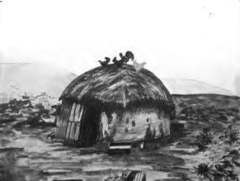
In cold or wet weather a fire will be made in the centre of the hut, the smoke finding its way to the upper air through the thatch and cracks of the door. At all other times the fire is made out of doors in some particularly sheltered spot, bearing the signs of many former fires. Knives, bunches of leaves (used for flavouring, smoking, or medicine), and other treasures are thrust into the thatch for safety. The beds take up little room in the daytime, being merely mats, which are rolled up when not in use.
Other huts are a strong contrast to the wellbuilt dwellings of the Kaffirs. Anything is good enough for the natives who build them, and any trouble too much. These habitations are not worth calling huts, being formed merely of a few boughs stuck into the ground and bent at the top, over which old sacks and rags are thrown to keep the wet out. The whole structure is hardly long enough to lie down in at full length.
The natives' home centre is their fire of wood, with the well-blackened three-legged pot over the red embers. Here they gather when work is done, and smoke, sing, and talk, often far into the night Comparatively, very few natives have what we might term a hobby. Some do a little gardening in their spare time, but the water difl&culty here is too great for much success or encouragement, so most of the huts stand in the midst of bare patches of ground. Most natives are fond of singing, and usually have fine voices, which are worth listening to, especially when blended in chorus. Some, too, seem to have a gifb for music. A few are clever carvers of pipes and sticks, such as are seen in every curio shop in South Africa, figured by means of red-hot irons into intricate designs of animals, fish, and birds. One man used to bring to our house for sale clay models of natives, horses, and baboons. These articles were hardened by baking, and were finished oflF with black and white pigments. The figures were armed with spears, the shafts of which were made of some stiflF fibre and the blades of clay ; shields and clubs were made of the same materials. Other natives are expert at capturing wild animals. The skins of these animals they dress, and then make them into various useful articles, such as wallets and bags. Some of the latter are made by sewing up the whole skin, including the legs and tail. When finished, the legs stand out straight and the tail forms a convenient handle. Nearly all true native skinwork is sewn with gut taken from the animal.
In our township very few of the natives wear the red blanket so often seen in other town locations. The greater part of our male coloured population are dressed in cast-oflF European clothing, mended with numerous patches of every variety of colour and shape. They usually add a coloured handkerchief tied round the head under a cap, and bead necklaces, including, if possible, jackals' teeth, which are valued as a charm. All natives are proverbially fond of coloured beads. I saw one man with a chain of beads round his neck like a Lord Mayor's in grandeur, to the end of which was suspended a purse, also laboriously edged in patterns of coloured beads. They are also fond of bracelets of twisted wire, plaited grass, or other material, which are conveniently adapted to the purpose. The most curious bracelet I ever saw was made from the skin of a large sea-turtle's foot and leg, cut into two parts and bent so that the claws met in the front.
The women often wear heavy bracelets of brass or copper, which sometimes extend from the wrist and half way up the arm, and necklaces of glass beads, or beads roughly cut out from medicinal roots, and valued as specifics for various ills.
Toilet cannot be indulged in by a native belle as it can by a white one. The native belles are at the disadvantage of only having a mop of close curls, which cannot be improved upon, beyond the tying of a ribbon round the head in Grecian fashion. If they want to look very grand, they tie a gorgeous silk handkerchief over their heads and under the chin, and clothe themselves in bright-coloured dresses. If they really want to " do-the-thing," they add to their other finery a pair of shoes and stockings and an umbrella! The shoes are often a size or two too small, but are worn (as long as any one is there to see) with a heroism worthy of a better cause; both shoes and stockings are, however, only for show, and are carried in the hand when no one is near to admire them.
Some of the men are dandies, and know how to put on airs as well as any of the white variety. These black dandies will sometimes appear in spotless black clothes and highly polished boots, a flower in the button-hole, light cane with silver handle, delicately tilted under the arm at the correct angle, a startling crimson tie, white stand-up collar and shirt front, and a white straw hat fastened to the coat by a hat guard. Such an apparition makes one realise that conceit is, after all, a cheap luxury, which can be indulged in with an equal amount of satisfaction by an almost penniless clown as by the noblest fop in the country.
I believe that I am justified in saying that most natives prefer being married according to Christian rites- if only for the sake of the ceremony. They revel in any kind of pageant. But Christians or not, the Kaflfirs almost always pay the parents in kind for their wives, usually cattle. About four years ago a man gave five cattle for his wife, the cattle were valued at five pounds each - not a bad price for a native to pay! That was before the rinderpest. Directly after the rinderpest, which swept most of the cattle from the country, thefts of what stock remained became common. Many of these thefts were believed to be traceable to young fellows who wanted to marry, but whose intended fathersin-law, with keen business instincts, were not willing to part with their daughters for anything less than cattle.
Wives are a good investment from a native point of view. Besides doing all the household work, which often includes such items as crushing mealies for the family, which is done by placing the *^ whole" mealies in the hollowed-out butt-end of a tree-trunk, and then pounding them with a large double-ended wooden pestle, they often add to the family purse by washing or charing for their white neighbours. When on a journey too, you will see the wives and women-folk laden to their full capacity with household goods, and probably a small child supported by a shawl upon her back, while the men walk along beside them, carrying nothing but one or two sticks.
A few years ago I witnessed a native wedding. The bridegroom came from a farm in the country, but the bride was a town woman. They were married in one of the native churches. The bride was dressed in white, and had a veil, black boots, and an umbrella. The bridegroom had on a black suit, bright tie, bowler hat, and new boots. There were three little girls as bridesmaids dressed in pink frocks, white stockings, and black boots. Each also had a pink umbrella. By the side of each bridesmaid was a fullgrown native man clothed in his Sunday best suit.
When the ceremony in the church was over, the party went to the house of the bride's father, where a feast had been prepared, for which the father, as is the custom, had provided an ox, not a fat one, and there were loud complaints about the toughness of the meat in consequence. The feast was followed by a dance or parade. The women formed themselves into line, and began to clap their hands in time to a monotonous song which rose and fell in volume. In front of them the wedding party marched solemnly up and down. A smartly-dressed native conducted the proceedings, walking or rather dancing backwards, using a furled umbrella aa a sort of baton. The bride and bridegroom came next, and were followed by the small bridesmaids, each with her gigantic caretaker, and all the umbrellas were spread out in full and dazzling display, without doubt causing bitter envy to many of the onlookers. This dancing, feasting, and singing continued all night, and itwasfongafterL sun had risen when the happy pair took their departure in a bullock waggon.
When about to take a long and hot journey by road or rail, the natives often rub over that part of their bodies, which would be exposed to the sun, a kind of pot clay, either yellow or red in colour, having moistened the clay before applying it to the skin. A party bedaubed like this, and squatting in a ring on their haunches, waiting for a train, their miscellaneous possessions scattered around them, make a picture which is both ghastly and grotesque.
No native starts on a journey without providing himself with one or more long plain sticks, which he uses either to walk with or upon which he hangs his special treasures. When needful, these long sticks are handy weapons to fight with. Two natives may often be seen going through all the actions, movements, and shouts of actual warfare with them by way of play and practice. When the natives arrive at the larger towns, the police usually disarm them of these long sticks, as they are considered dangerous, and are often freely used in drunken brawls.
At work, raw natives do not get on well singly, but have to be set on their job in couples or companies, a monotonous song keeping rhythm to their motions. It is interesting to watch a gang of coloured labourers, say digging on the railway. Few seem satisfied to go quietly to work as an English workman would, but dig to sundry ejaculations, turning their spade around in the air, looking brave and sometimes dancing.
Native labourers, with all other Government employes on the Cape Railways, are paid once a month. Pay-day is a busy day for the storekeepers, and an anxious one for the wives of the coloured men, many of whom manage to get fairly drunk before their wives can find them. But when these coloured amazons do find their drunken spouses, they bundle them home without ceremony, to the accompaniment of a shrill jargon.
Drink is one of the curses of South Africa, as it is of all the countries of the world. The natives cannot be expected to possess the restraint which is natural to every evenminded European, and the only way to cure native drunkenness is to altogether do away with the canteens and the supply of liquor to them. But this is not likely to be done, where there is so much vested interest concerned, and perhaps a certain amount of conscience on the part of those whites who, having very liberal facilities for drinking themselves, would say, if asked to sign a paper for stopping the supply of liquor to the natives : " Poor beggars, let them have their drink for all I care ! " - and the next day very probably would dismiss one of their own coloured hands for being drunk. Immorality amongst a certo class of natives is poverbial, perhaps it may be called excusable, seeing that to them it does not seem immoral, for they were never taught otherwise. Where incalculable harm is done, is when whites encourage them in their evil practices. That this is a fact is painfully evident beyond all possibility of denial in any gathering of native children on a township like ours. I believe that things are not so bad as they have been. May God grant that the change for the better may be maintained and improved.
Every one who believes in teaching the doctrines of Christianity to the natives, I think, agrees that it will be best done by the means of properly instructed native teachers. But far more are needed. It is a pity that those already there do not pull together, instead of wrangling with each other under the names of different sects ! I know that many oppose the teaching of Christianity to natives altogether, one reason being that (as they say) " It is the thin end of the wedge. Pastors are leaders of the people, and this religious movement is the beginning of a native power, which will end in bloodshed, for the natives look up to their leaders, and there are sure to be revolutionary pastors.' Another reason often given for not teaching them Christianity is, that it makes them "useless as labourers, for they learn to look on whites as merely their equals, and consequently put on airs and won't work." Christians who use these arguments show a very poor belief in Christianity, whose fruits are given in Gal. v. 22-24. As to the pastors becoming revolutionary leaders of the coloured peoples, leaders they will have, and must have, of some kind, and it is better that they should be men who are instructed in the peaceful doctrines of Christianity, than mere savages with nothing better than what is called "civilization," to raise them above their savagery. My own experience with professing Christian natives has been in every way satisfactory. They have been honest and straightforward, steady and industrious. Treat your native servants like human beings, pay them well as native labourers, show them that you appreciate good work, be firm but kind, and they will serve you faithfully, and will not be apt to run away from you as soon as they have learnt something, which those servants do who have unjust masters.
In education, many seem to think that a native is not fitted for daily life under the present circumstances, unless he has a high college education! This idea is about as right as it would be to try and improve a few children and young people from the London slums, by giving them a high college education, with the hope of making the slum districts more fit for present-day life by so doing. What the natives do want is a good grounding in the three R's to make them a useful people, and encouragement and help in such occupations as gardening, to make them a home-loving people.
It is only fair to quote from an extract showing very clearly the other side of the question : -
"They (the natives) feel their ignorance; they see that it daily exposes them to deception and outrage from better-instructed neighbours; very few can read the laws that are passed for their benefit or learn from the newspapers how their interests are being dealt with by those in authority. Hence their very natural desire for the education of their children, not elementary only, but of the highest grade possible to which they may be able to attain."