7. Building Empires Overnight
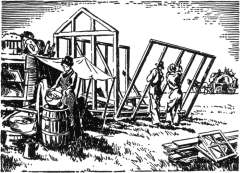
That spring I saw a country grow. Perhaps Rome wasn't built in a day, but the Brulé was--almost. The incredible speed of the transformation of the untouched plains; the invasion of the settlers in droves, lighting on the prairies like grasshoppers; the appearance, morning after morning, of new shacks, as though they had sprung up overnight; the sound of hammers echoing through the clear, light air; plows at last tearing at the unbroken ground--the wonder of it leaves me staggered now, but then I was caught up in the breathless rush, the mad activity to get things done. The Lucky Numbers were coming, coming.
A few weeks before, we had set up our shack in a wilderness. Now there were shacks everywhere and frantic activity. The plains had come to life. Over them, where there had been bleak emptiness, loomed tents, white against the green background, where the settlers could sleep until they were able to build houses. There was no time to rest, no time to pause--here where there had been nothing but time.
Late one evening a wagon loaded with immigrant goods and a shabby car loaded with children passed our place. The drivers stopped on a nearby claim, threw their bedding on the ground, and slept there. Their deadline for establishing residence was up that night. All over the plains that intensive race went on, the hurried arrival of settlers before their time should expire, the hasty throwing up of shelter against the weather, the race to plant crops in the untamed soil so that there would be food later on.
A land where one must begin at the beginning! Everything to be done, and things crying to be done all at once. Those three basic needs, food, fuel, water--problems which must be solved without delay.
Moving in a network, criss-cross in every direction, wagons and teams hauled in immigrant goods, lumber and machinery, fence posts and fuel; post holes supplemented those dug by the prairie dogs; strings of barb-wire ran threadlike over the unbroken stretch.
From day to day we saw the prairie change, saw new, crude houses thrown up, saw the first furrows broken in the stubborn soil, saw men and women pit themselves against the frontier and shape it to their purpose and their needs.
Among these people there were many more dirt farmers than had settled around McClure, but at least 50 per cent of the immigrants were young men and women from various walks of life, business and professions, who had come for health or adventure; or because the land, through sale or mortgage, would give them a start in life. While it is doubtless true that these latter contributed little to the permanent building of the West, the zest with which they enjoyed its advantages, the gallantry with which they faced its hardships, contributed no small part to increasing the morale of the settlers as a whole.
Almost every settler scooped out a dam at the foot of a slope for water supply. We had Chris Christopherson plow one for us. These dams were nothing but waterholes twelve to fifteen feet in diameter and two or three feet deep. There should be late spring rains to fill them for the summer. There were! While the settlers were still plowing and planting and making their dams it began to rain. And when the frontier is wet, it's wet all over. Dry creeks swelled to overflowing, and small ravines became creeks, and it kept on raining. Both Ida Mary and I were caught in one of those downpours and had to swim the horses across swift-rising Cedar Creek.
Much of those first days were like chapters from Genesis, and to add to the similarity we now had the Flood! The seed shot out of the ground and the fields were green. The gardens grew like Jack's beanstalk. The thick grass stood a foot high. And the dams were full of water.
And Ida Mary and I were literally in the center of this maze of activity, this mushroom growth of a country. And Ammons was actually on the map!
My sister wrote to the Postal Department for a mail carrier and found out she would have to solve that problem for herself.
"We aren't cut out to cope with the plains," I said.
"How did you happen to find that out?" asked Ida Mary.
"I didn't. A New York broker told me."
We had to find some way to get mail in and out. We couldn't back up on the trail, once we had started. There was no place to back to. So we bought a team and started a U. S. mail route, hauling mail three times a week from the stage line at McClure.
It was the thing that had to be done, but sometimes, when we had a moment for reflection, we were a little aghast. Carrying a mail route in homestead country was a far cry from life in St. Louis. It began to seem as though we rarely acted according to plan out here; rather, we were acted upon by unforeseen factors, so that our activities were constantly shifting, taking on new form, leading in new directions. The only consistent thing about them was that they never back-trailed!
Now and then we hired boys to help us with heavy jobs which were beyond our strength, and occasionally a young prairie girl, Ada Long, fourteen years old, went for the mail. It was against the law to let anyone who happened to be handy carry the mail, but the settlers had to have postal service.
Ada was fair, with long yellow braids, strong and accustomed to the hard ways of the prairie. She could hitch up a team and drive it like a man. There was only one drawback to Ada. On Saturday when we were busiest she went home and to church; and on Sunday she hung out the washing. Ada was a loyal Adventist.
Settlers meeting on the trail hailed one another with "Hello! Where you from? I'm from Illinois"--or Virginia--or Iowa. "You breakin'?" They had no time for backgrounds. It didn't matter what the newcomers might have been. That was left beyond the reservation gate. One's standing was measured by what he could do and what kind of neighbor he would make. And always the question, "Where you from?" Missouri, Michigan, Wisconsin.
Bronco Benny, riding through one day, said, "I never seen so many gals in my life. Must be a trainload of 'em. Some pretty high-headed fillies among 'em, too." Bronco Benny knew no other language than that of the horse world in which he lived.
Not only dirt farmers but many others became sodbreakers. The sod was heavy, and with the great growth of grass it took all the strength of man and teams, four to six horses hitched to a plow, to turn it. Steady, slow, furrow by furrow, man and beast dripping with sweat, they broke fields of the virgin earth.
How deep to plow, how to cultivate this land, few of them knew. The more experienced farmers around the Strip, like Huey Dunn, would know. Here was a service the newspaper could perform by printing such information for the newcomers. Subscriptions for the paper began coming in before we were ready to print it. We named it The Reservation Wand, and how it ever was accepted in that man's country with a name like that is beyond me. The first issue was distributed by homesteaders passing by and two carriers.
Subscriptions came in rapidly at a dollar a year. Not only did most of the settlers subscribe, but they put in subscriptions for friends and relatives, so that these might know something of the country and its activities. And in their rush of getting settled it was easier to have the printer set up the news and run it off on a press than to take the time to write a letter. Outsiders could not send in subscriptions by mail until the newspaper had an address other than a section number of the claim on which it was printed.
Food, shelter, fuel were still the pressing problems. An army had peopled a land without provisions. Trade was overwhelmed and the small towns could not get supplies shipped in fast enough. New business enterprises were following this rush as lightning does a lightning rod. There was bedlam. One could not get a plowshare sharpened, a bolt, or a bushel of coal without making the long trip to town. One could not get a pound of coffee or a box of matches on the whole reservation.
The settlers began to clamor for a store in connection with the newspaper and the post office. Their needs ran more to coffee and sugar and nails than to newspapers. They had to have a store for a few essential commodities at least.
A store? I objected strenuously. We had already embarked on enough enterprises, and running a store had no place among them. But practical Ida was really interested in the project. It wasn't such a bad idea, she decided. Our money was dwindling, the newspaper would not become a paying proposition for some time, and the only revenue from the post office was the meager cancellation of stamps.
We could hire the hauling done, she pointed out, grappling at once with the details. And it would be a real service to the settlers. That was what we had wanted to provide--the means didn't matter so much.
So we planked down a cash payment at a wholesale-retail store at Presho for a bill of goods, got credit for the rest of it, threw up an ell addition on the back of the shop for the newspaper, and stuck a grocery store where the newspaper had been.
All this time we had been so submerged in activities connected with getting settled, starting and operating a newspaper, a post office, and now a store, that we had overlooked a rather important point--that on an Indian reservation one might reasonably expect Indians. We had forgotten the Indians.
And one afternoon they came. On horseback and in wagons, war bonnets and full regalia glittering in the sun, the Indians were coming straight toward the Ammons settlement. Neither of us had ever seen an Indian outside of a Wild West show.
We were terrified. Into the shack we scurried, locked doors and windows, and peeped out through a crack in the drawn blind.
The Indians had stopped and turned their horses loose to graze. We could hear them walking around the store and print shop--and then came savage mutterings outside our door and heavy pounding. We crawled under the bed. A woman we knew had escaped being scalped once by hiding behind a shock of corn. But there was no such refuge here.
"How! How kill 'em?" an old Indian was bellowing. No use trying to escape. This was the end.
Trembling, hearts pounding, we opened the door. Two big savage-looking creatures with battered faces stood there motioning toward the shop where a group of them were sauntering in and out.
"How kill 'em?" they still muttered. Dazed, we followed them. They had taken possession of the shop. Women were sitting on the floor, some with papooses strapped to their backs. Men with hair hanging loose, or braided down their backs, tied with red string, were picking up everything in the print shop, playing like children with new toys.
They led us into the store, muttering, "Shu-hum-pah; she-la," as they pointed to the shelves. At last we found they wanted sugar and tobacco, and we lost no time in filling the order.
At sunset they rode away toward the Indian settlement, and we discovered that we had been misled by the talk of "segregation." To us that had meant that the Indians were behind some high barricade. But there wasn't a thing to separate us from the tribe but another barb-wire fence, with the gates down.
For several days after the red men came we moved in a nightmare of fear. The Sioux had cherished this tall grass country as a hunting ground, and we had invaded it. Suppose they were intent upon revenge!
Then, absorbed in our many duties, we almost forgot about the Indians. But a week after their first visit they came again. They arrived shortly before sundown, adorned in beads and feathers, stopped across the trail, and to our horror pitched camp. Pinto commenced to neigh and kept it up, a restless whinny, eager for his own people.
It looked as though the whole Sioux tribe had moved over to Ammons. While the men unhitched and unsaddled, the squaws--for the most part large shapeless creatures totally unlike the slim Indian maid of fiction, and indescribably dirty--started small fires with twigs they had brought with them. By now Ma Wagor, the gray-haired woman from Blue Springs, was in the store every day, helping out, and she was as terrified as Ida and I. It seems there were no Indians in Blue Springs. They were among the few contingencies for which Ma Wagor was not amply prepared.
By chance a strange cowboy came through about sundown and stopped for a package of tobacco. While he dexterously rolled a cigarette with one hand we surrounded him, three panic-stricken women. Did he think the Indians were on the war path, we asked, our teeth chattering.
"Oh, I don't know," he answered carelessly, "can't tell a speck about an Indian. Couldn't blame 'em, could you, with these landgrabbers invadin' their range?"
The logic of this had already occurred to us, and we were not particularly cheered by the cowboy's confirmation of our worst suspicions.
"What do you suppose they're buildin' them fires for?" Ma Wagor was anxious to know.
Sourdough couldn't say as to that. But he 'lowed it might be to burn the scalps in.
At that we missed Ma. She had slipped into the house to wash her feet. Ma was a great believer in preparedness, whether having something cooked ahead for supper, or clean feet for heaven.
Instinctively I put my hand on my shock of fair hair to make sure it was still in place. It had always been a nuisance, but now I felt a passionate eagerness to keep it where it was.
The Indians stretched their tepees and cooked their supper. The prairie around them was alive with bony horses and hungry-looking dogs. It was the impatient yelping of the dogs about the kettles rather than any sounds from the soft-footed Indians which we heard.
The cowboy threw his cigarette on the floor, stamped on it with a jingle of spurs, and drawled, "Guess I'll be percolatin'--got to ride night-herd."
Ma Wagor grabbed him by his wide belt. "You're goin' to do your night-herdin' right in front of this shack," she declared grimly. "You've got your pistol and we women need protection." Looking at Ma's set jaw he promised to hang around that night.
Locked in the shack, we waited for the cowboy's signal of attack. He'd "shoot 'em down as fast as they crossed the trail," he assured us, but we were not so confident of his prowess.
"I'd send for Pa," Ma Wagor said dismally, "but what good would he do? And one of us has got to be left to prove up the claim." It was unlikely, according to Ma, that anyone in that cabin would survive. But as the night wore on everything across the trail became quiet and at last we threw ourselves across the bed, exhausted. We woke next morning to find our cowboy gone and the Indians cooking breakfast.
Two leather-skinned men with hair hanging loose over their shoulders and faces painted in red and copper hues led a big-boned horse up to the door and walked into the store. They pointed to the shelves, held up ten fingers, then pointed to the horse. They wanted to trade it for ten dollars' worth of groceries.
Ida Mary did not bother to look at the horse. She traded. The last thing that would have occurred to her at that moment was to disagree with any wishes the Indians might express. We found out later that the old mare was stone-blind and locoed.
Within a week we had the corral full of horses--the lame, the halt and the blind. We would have traded the whole store for anything that the Indians wanted, to get rid of them.
Sourdough, who belonged to the Scotty Phillips outfit over on the Indian lands, had ridden straight on to do night-herd duty. Every cowpuncher, it seemed, must play at least one trick on the tenderfeet.
Then one day a handsomely built young buck, straight as an arrow, walked into the print shop. "How Kola!" he said, and then introduced himself as Joe Two-Hawk. He was a college graduate, it appeared, and he explained that "How Kola" was the friendly greeting of the Sioux, a welcome to the two white girls who ran the settlement.
Many of these young Indians went East to Indian colleges, acquiring, along with their education, a knowledge of civilized ways to which they adapted themselves with amazing rapidity. On returning to the reservations, however, in many cases, perhaps in most, they discarded one by one, as though they had never been, the ways of the white man, and reverted to their primitive customs and ways of life. Nor should they be too thoughtlessly condemned for it. Among civilized peoples the same urge for an escape from responsibility exists, thwarted often enough merely by necessity, or by the pressure of convention and public opinion. The Indians who have reverted to type, discarded the ways of civilization for a tepee and primitive uncleanliness, follow the path of least resistance. Traditions of accomplishment as we know them have no meaning for the Indians; and the way of life for which his own traditions have fitted him has been denied him.
How Kola! That must be what the old warrior was bellowing the day we thought he had said he would kill us. Old Two-Hawk laughed at that when his son Joe interpreted it in Sioux.
Old Two-Hawk explained us to his son, of whom he was manifestly very proud. He pointed to me. "He-paleface-prints-paper"; then to Ida Mary, "Him-paleface-trades-horses." Thus the Brulé Indians distinguished us from each other.
Joe Two-Hawk had come as a sort of emissary from the Brulés. They wanted us, he explained, to make Ammons an Indian trading post. Looking at the corral, we felt, to our sorrow, that they had already done so. Joe Two-Hawk said they had wood and berries in abundance along the Missouri River, which ran through the Indian lands. They wanted to exchange them for merchandise. And the settlers, we knew, needed the Indian commodities.
So to the newspaper, the post office, the store, the mail route, the heavy hauling, we added an Indian trading post, trading groceries for fence posts; subscriptions to The Wand for berries--very few of them could read it, but they didn't mind that--it was a trade. Joe Two-Hawk became a mediator and interpreter until Ida Mary and I learned enough of the Sioux language to carry on. We tried to figure out a way, in this trading, to make back our loss on the menagerie we had collected at Ammons. Those bare store shelves worried us. Then, one morning, the old, blind, locoed mare turned up with a fine colt by her side. We were getting even.
And we no longer minded that the gate was open between the Indian lands and the section of the Brulé which had been thrown open to white settlers. While the gate stood open, enmity and mutual suspicion could not exist, and the path between it and Ammons was beaten hard and smooth.
The Indians came in processions with loaded wagons; unloaded, turned their horses loose on the range and sat around--men and women--for hours at a time on floor or ground, dickering. Ida Mary became as expert at it as they were. It was not long before The Wand had legal work from them, the settling of estates, notices pertaining to land affairs, etc. And that led, logically enough, to Ida Mary's being appointed a notary public.
"Want to sell your land, girls?" a man from Presho asked us one day. "That's what I drove out for. I have a buyer anxious to get a claim on the Brulé and I believe he would pay $1200 for this relinquishment. A quick profit."
"Sell? No!" we declared. "With such demand for land on the Strip we may be able to get $2500 for it when it is proved up."
He agreed. A raw quarter-section of deeded land just outside the border had sold the other day for $3500, he informed us. With all the breaking and improvement going on over the Brulé, it was predicted by real-estate boosters that choice homesteads here would be worth $4000 to $5000 in another year or so--after the land was deeded.
Within sixty days after the arrival of the first Lucky Number on his claim the 200 square miles of the Brulé would be filled. The winners had filed consecutively, so many numbers each day for that length of time. Their time to establish residence would thus expire accordingly. Already the broad expanse of grassland we had seen during our first week on the Brulé was changed beyond recognition, shacks everywhere, fields plowed, movement and activity. The frontier had receded once more before the advancing tide of civilization. Within sixty days!
With the price of claims soaring, it became a mecca for claim jumpers. They circled around ready to light on the land like buzzards on a carcass. They watched every quarter-section for the arrival of the settler. If he were not on his land by dark of the last day, some "spotter" was likely to jump the claim and next morning rush to the Land Office and slap a contest on it.
They were unlike the claim jumpers of the older pioneer days who jumped the land because they wanted it for a home. Many of these men would not have proved up a claim at any price. But in many instances they brought landseekers with them who legally filed contests and homesteading rights over the settler. They paid the claim jumpers well for their services in getting hold of the land. Often, being strangers, the landseekers did not know that these "spotters" were not land agents.
They were a ruthless lot as a whole, these claim jumpers. They took long chances, illegally selling relinquishments and skipping the country before they were caught. Some of them even threatened or intimidated newcomers who knew nothing about the West or its land laws.
Of a different type were unscrupulous locating agents who used the technicalities of the homestead law to operate the despicable "contest" business. Whether they had any grounds for contesting a homestead or not, they could claim they had, and the settler must then either go to trial to defend his rights or give up the land. It was a serious problem for the settlers.
So many strangers came and went that the homesteaders seldom identified these land thieves, but the print shop, set high in the middle of the plains, was like a ranger's lookout where we could watch their maneuvers; they traveled in rickety cars or with team and buggy, often carrying camping equipment with them. By the way they drove or rode back and forth, we could spot the "spotters."
They often stopped at the settlement for tobacco or a lunch out of the store--and a little information.
"Whose shack is that off to the southwest?" a man asked one morning, reading off the claim numbers from a slip of paper. He was a ruddy-faced man dressed in a baggy checkered suit with a heavy gold watch chain across the front of his vest and a big flashy ring.
"Belongs to a woman from Missouri," Ida Mary told him. "She had a neighbor build the shack for her."
"No one living there," he said.
"Oh, yes," Ida Mary improvised rapidly, "she was in here yesterday on the way to town for furniture. Won't be back until tomorrow night."
He looked doubtful. "Doesn't look to me as though anyone ever slept there. Not a thing in the shack--no bed."
Ida Mary called out to me, "Edith, didn't you lend that woman some bedding yesterday?"
"Yes," I declared, "so she could sleep there a few nights before the deadline."
All our early training in truth-telling was lost in the skirmish, and sometimes I doubted if the truth was left in us. But there was zest in this outwitting of men who would have defrauded the settlers if they could.
One day I noticed two men driving back and forth over a vacant claim nearby. At sundown no one had established residence. I watched the maneuvers of the two men.
"Ida," I called, "those men are going to jump that claim."
I looked over my land plat and saw that the homestead belonged to Rosie Carrigan from Ohio. It was the last day of grace. She had until midnight to get there.
It was a moonlight night. Ida Mary saddled Pinto and rode down the draw toward the claim. From a slope where she could not be seen she watched the two men. The evening wore on. At eleven o'clock, secure in the knowledge that the owner had failed to arrive, the men pitched camp.
Ida Mary rode quietly up the draw and galloped up to the cabin. "They are sleeping on the claim," she said breathlessly. This meant that next morning, as soon as the Land Office opened, one of them would be there to slap a contest on the land, while the other held possession. It also meant that when Rosie Carrigan arrived she would find her homestead gone.
"What shall we do?" I asked anxiously.
Ida Mary considered for a moment. "One of us must be Rosie Carrigan," she decided. She ran out to hitch the team to the wagon while I hurriedly dragged a few things out of the house and loaded them--things such as an immigrant must carry with him, bedding, boxes, a traveling bag or two. We threw them in the wagon, circled off a mile or two, and then drove straight back onto the land. A few rods from the claim-jumpers we drove a stake, hung a lantern on it, and began to unhitch, shivering with excitement and apprehension.
The noise of our arrival roused the two men, who stirred, and then with an exclamation got to their feet. We saw the flare of a match. One of them had drawn out his watch and was looking at it. Under the smoked-lantern light we looked at ours--it was ten minutes to twelve!
We heard them murmur to each other, but continued unhitching the horses, dragging the hastily assembled articles out of the wagon. Then my heart began to pound. One of the men walked over to us. He was short, burly, heavy-jawed.
"Here, you can't stay here! Where do you think you are?" he demanded.
We made no answer, but the bed I contrived to make under his watching eyes was a hopeless tangle.
"We're on this land ..." he blustered. He was trying to run a bluff, to find out whether we were on the right quarter-section or whether, like him, we were land-grabbers.
"I guess I'll have to have your identification," he said again. "What's your name?"
"Rosie Carrigan," I answered, "from Ohio. What are you doing on my land, anyway? You have no right here!"
He hesitated, weighing the situation and the possibilities.
"Get off!" I blazed at him.
He got. The two men rolled up their bedding and moved on, and Ida Mary and I sat limply on the ground watching them go.
In case they should come back we decided to hold the land for the night, gathered up the bedding, and slept in the wagon--when we slept.
At daybreak we were wakened by the rumble of a heavy-loaded wagon coming slowly over the prairie behind a limping team. A tall, slim girl and a slight boy sat high on the front seat. They drove up beside our wagon. Fastened on the back of their load was a chicken coop, and as they stopped a rooster stuck its head out and crowed.
The girl was Rosie Carrigan. The boy was her brother. And the rooster was the first of his kind to settle on the reservation. They had been delayed by footsore horses. But no land-grabbers, no one except ourselves, ever knew that Rosie Carrigan did not establish residence at ten minutes before midnight.
Not long after this, a rough-looking stranger rode up to an old man's shack and took some papers out of his pocket. "There's some mistake here, pardner," he said. "Looks like you're on the wrong quarter. This is section--" he read the description, "and it happens to be mine."
"But that's the number of the claim I filed on at the Drawing," the old man assured him.
After much arguing and bullying, with the old man contending he was right, the stranger ordered him off the land.
"You don't pull that stuff on me, pardner; you'd better vacate."
"Now keep your shirt on, stranger," the old man said, with a twitching of his long white mustache, inviting him in for a bite to eat while he hunted up his land receipts.
"I'm all crippled up with the rheumatiz," he groaned as he hobbled back into a corner of the room to get the papers. "A pore way for the gov'ment to open up land, I says.
"Now down in the Oklahomy Run we used speed and brains to stake a claim, beating the other fellow to it. But it was a tough bunch down there, and sometimes, stranger, we--" he turned and pointed a gun straight at the man seated at the table, "we used a gun."
The old man who had stood leaning on his cane at the Drawing, complaining that neither legs nor brains counted in winning a claim, used his ingenuity to hold one.
During those last days of settling, Ida Mary and I lived in a state of tension and suspense. We watched our land plat and often rode out over the prairie to watch for the arrival of settlers whose land was being spotted. After a few of our deceptions, the claim jumpers became wary of the newspaper and cursed "that snip of a newspaper woman." And the girl who ran the post office was a government employee.
Here was a job for The Wand. In the next issue there appeared a black-headline article. It began:
"It has been reported that owing to the swift settlement of the Brulé, Secret Service Agents from the Federal Land Department are being sent out to protect the settlers against claim jumpers who are said to be nesting there. This tampering with government lands is a criminal offense, and it is understood that legal action will be pushed against all offenders."
One afternoon some two weeks later there walked into the print shop a man with an official manner about him. He called for the publisher of the paper.
"What do you know about this?" he demanded, pointing to the article. "What authority did you have for it?"
I was speechless. He was a Federal Agent.
"Well," I said at last, defiantly, "if the government is not furnishing agents on the land to look after these things, it should."
And it did. The agent looked into the matter, claim-jumping quieted down, there were fewer "spotters" swarming around, and soon, when their six months of grace had expired, the Lucky Numbers were all on the ground.