0. General Information
Dear readers,
Land of the Burnt Thigh by Edith Eudora Kohl with illustrator Stephen J. Voorhies was published in 1938.
The content on this website is made possible courtesy of Project Gutenberg. Their volunteers have done a tremendous job of digitizing tens of thousands of books and then making them available for free download. I've selected some of the books and formatted them on my websites for easy reading from iPhone, Android, and similar mobile phones.
The images on this website are taken from http://www.gutenberg.org/files/24352/24352-h/24352-h.htm.

K. C. Lee
Mobile Story Enthusiast
From Project Gutenberg: This eBook is for the use of anyone anywhere at no cost and with almost no restrictions whatsoever. You may copy it, give it away or re-use it under the terms of the Project Gutenberg License included with this eBook or online at www.gutenberg.net.
TO
THE MEMORY OF
IDA MARY
A Word Of Explanation
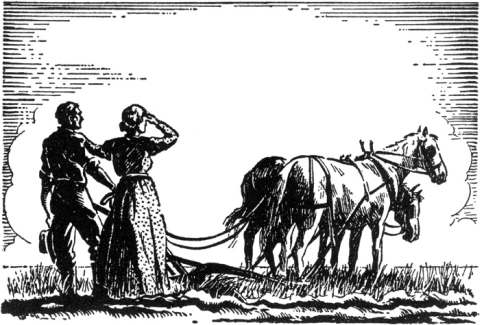
I have not attempted in this book to write an autobiography. This is not my story--it is the story of the people, the present-day pioneers, who settled on that part of the public lands called the Great American Desert, and wrested a living from it at a personal cost of privation and suffering.
Today there is an infinite deal of talk about dust bowls, of prairie grass which should never have been plowed under for farming, of land which should be abandoned. Yet much of this is the land which during the crucial years of the war was the grain-producing section of the United States. Regiments of men have marched to war with drums beating and flags flying, but the regiments who marched into the desert, and faced fire and thirst, and cold and hunger, and who stayed to build up a new section of the country, a huge empire in the West, have been ignored, and their problems largely misunderstood.
The history of the homesteaders is paradoxical, beginning as it does in the spirit of a great gamble, with the government lotteries with land as the stakes, and developing in a close-knit spirit of mutual helpfulness.
My own part in so tremendous a migration of a people was naturally a slight one, but for me it has been a rewarding adventure, leading men and women onto the land, then against organized interests, and finally into the widespread use of cooperative methods. Most of that story belongs beyond the confines of the present book.
Over thousands of acres today in the West men and women are still fighting to control that last frontier, and wherever there are farmers, the methods of cooperation will spread for decades. It is a good fight. I hope I shall be in it.
E. E. K.