10. The Harvest
I was pony-expressing the mail home one day when I saw a great eagle, with wings spread, flying low and circling around as though ready to swoop upon its prey. It was noon on a late fall day with no sight or sound of life except that mammoth eagle craftily soaring. I turned off the trail to follow its flight. It was the kind of day when one must ride off the beaten trail, when the sun is warm, the air cool and sparkling; even Lakota seemed like a stodgy animal riveted to the earth, and the only proper motion was that of an eagle soaring.
Abruptly the eagle swooped down into the coulee out of sight and came up a hundred yards or so in front of me, carrying with it a large bulky object. At the same instant a shot rang out, the eagle fell, and its bulky prey came down with a thud.
So intent was I upon the eagle that I was not prepared for what happened. At the shot Lakota gave a leap to the right and I went off to the left. I had no more than landed when a rider, whom I had seen lope up out of the coulee as the eagle fell, had my horse by the bit and was bending over me.
"Hurt?" he asked.
"I don't think so. Just scared," I replied as I got stiffly to my feet. The soft, thick grass had provided a cushioned landing place and saved my bones.
The stranger took a canteen from his saddle and gave me a drink of water; led the horses up to form a shade against the bright noon sun, and bade me sit quiet while he went back to see what the eagle had swooped down upon.
"A young coyote, just a pup," he announced upon his return. "I'm glad I got that fellah. They are an awful pest." It was a big bird with an eight-foot stretch from wing tip to tip as measured by this plainsman's rule--his hands. "They carry away lambs and attack new-born calves," he said. "They attack people sometimes, but that is rare."
He helped me on my horse. "All my fault. Couldn't see you from down in the coulee when I fired at that bird. You musta just tipped the ridge from the other side." He reached over, untied the mail bag and tied it to his saddle.
"You were going the other way, weren't you?" I protested.
"No hurry. I'll go back with you first."
"You don't know where I live, do you?"
"Yes, I know," he said laconically. He was a young man--I took him to be under thirty--with a sort of agile strength in every movement. Lean, virile, his skin sunburnt and firm. He wore a flannel shirt open at the throat, buckskin chaps, a plainsman's boots, and his sombrero was worn at an angle. He made no attempt to be picturesque as did many of the range riders.
As the horses started off at an easy gallop he checked them. "Better go slow after that shake-up," he said quietly.
"I must hurry," I answered. "I'm late with the mail."
"These homesteaders are always in a rush. Shore amusin'. Act like the flood would be here tomorrow and no ark built." He spoke in a soft, southern drawl.
"They have to do more than build an ark," I told him. "They have to make time count. The country is too new to accomplish anything easily."
"Too old, you mean. These plains have been hyar too long for a little herd of humans to make 'em over in a day."
"We have fourteen months to do it in," I reminded him, referring to the revised proving-up period.
"You'll be mighty sore and stiff for a few days," he said as he laid the mail sack down on the floor; "sorry, miss, I scared your horse," and touching his ten-gallon hat he was gone.
"Where did he hail from?" Ma Wagor demanded from the store where she had been watching.
"He's not from Blue Springs, Ma."
"I declare you are as tormentin' as an Indian when it comes to finding out things," Ma exclaimed in disappointment. She couldn't understand how I could have ridden any distance with the man without learning all about his present, guessing at his past, and disposing of his future to suit myself. People, as Ma frequently pointed out, were made to be talked to.
Just before sunset one day a week or so later I was sitting in the shop when the cowboy walked in. "Got to thinkin' you might be hurt worse than you appeared to be." He said he was top hand, had charge of a roundup outfit over in the White River country some fifty miles away, and some of the stock had roamed over on the reservation. Name was Lone Star--Lone Star Len.
And then one gray, chilly day in November, with the first feathery snowflakes, he rode up on his cow pony to say good-by. He was leaving the country, taking a bunch of cattle down to Texas for winter range. He was glad to be going. "Don't see how folks can live huddled up with somebody on every quarter-section. Homesteaders is ruinin' the country, makin' it a tore-up place to live. It's too doggone lonesome with all this millin' around."
When the Brulé became populated, Lone Star Len had gone into the empty Rosebud country, "where I'm not hemmed in by people, some place where there's a little room." Now he would be driven on--and on. And in the spring there would be a new influx of people in our section of the frontier.
Meanwhile, fall had come. The plains, which had stretched to the horizon that spring untouched by a plow, unoccupied by white men, were now unrecognizable. A hundred thousand acres of fertile waste land had been haltered. Hundreds of settlers had transplanted their roots into this soil and had made it a thriving dominion. Fall rains filled the dams and creeks. There were potatoes and other vegetables in abundance.
Think of it! Caves full of melons, small but sweet. The Wand told of one small field that yielded twenty bushels of wheat, another twenty-two bushels of oats, to the acre. There was fall plowing of more ground, schools being established, Sunday schools, preparations for the winter already in progress.
Never had a raw primitive land seen such progress in so short a time. And The Wand had played a substantial part in this development. It was swamped with letters of inquiry.
Fall was roundup time on the range. The Indian lands were so far-reaching that there were no nearby ranches, but the herds ranged over miles of territory around us.
And across the fence, on the unceded strip, the great herds of Scotty Phillips's outfit roamed over his own and the Indians' holdings. Across the plains came the ceaseless bawling of thousands of cows and calves being separated. That wild, mad, pitiful bawling rent the air and could be heard through the stillness of night for miles around, and the yelling and whooping of cowboys, the stamping of cow ponies and herds, the chanting and tom-toms of the Indians.
And enveloping it all, the infinite plains, unmoved, undisturbed by all that was taking place upon them.
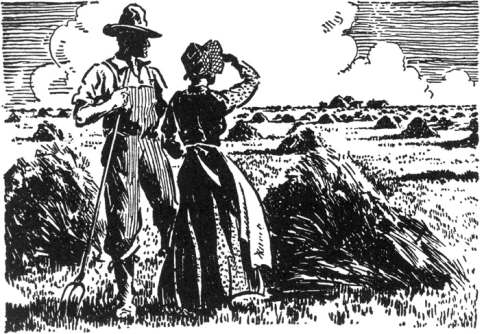
So the homesteaders gathered their first harvest, and the goose hung high. There was hay--great stacks and ricks of it. Piles of yellow corn stacked like hay in barbed-wire enclosures or in granaries. To commemorate that first golden harvest, the pilgrims of the Lower Brulé celebrated their first Thanksgiving.
Seeing the stacks of grain that stood ready for threshing or for feeding in the straw, old man Husmann pointed to the field. "Mein Gott in Himmel! Vat I tell you? Das oats made t'irty bushels an acre. And flax. Mein Gott! She grow on raw land like hair on a hog's back. Back in Ioway we know notings about flax for sod crop." Dakota taught the United States that flax was the ideal sod crop.
The average yield of oats with late and slipshod sowing had been around fifteen bushels to the acre. Some fields of spring wheat had run fifteen bushels. And potatoes had fairly cracked the ground open. One settler, an experienced potato grower, had four acres that yielded 300 bushels. The Wand played that up in headlines for easterners to see.
Late-ripened melons lay on the ground, green and yellow--watermelons, muskmelons, golden pumpkins ready for the Thanksgiving pie. Over the Strip women and children were gathering them in against a sudden freeze. The reservation fairly subsisted on melons that fall. Before the harvest the rations had been getting slim, with the settlers' money and food supply running low.
Women dried corn, made pumpkin butter and watermelon pickles, and put up chokecherries. A number of them had grown in their gardens a fruit they called ground cherries. This winter there would be baked squash and pumpkin pie.
So there was food for man and beast. And Scotty Phillips who owned what was said to be the largest buffalo herd in America killed a buffalo and divided it among the settlers, as far as it would go, to add to the Thanksgiving cheer of the Brulé. There was a genuine sense of fruition about that first harvest. Looking back to the empty plains as they had stretched that spring, the accomplishments of the homesteaders in one brief summer were overwhelming. There had been nothing but the land. Now a community had grown up, with houses and schools, and the ground had yielded abundantly.
In other ways our efforts had also borne fruit. There was to be a new bridge at Cedar Creek. From the fight The Wand had carried on, one would think that we were boring a Moffat tunnel through the Great Divide. And The Wand fought a successful battle with John Bartine over county division. It had come about when Senator Phillips came by one day during the summer on his way from Pierre to his ranch. "Scotty" Phillips, senator, cattleman and business man, was one of the Dakotas' most influential citizens. A heavyset man he was, with an unconscious dignity and a strong, kindly face; a squaw man--his wife was a full-blooded Indian who had retained many of her tribal habits. One day one would see the Senator ride past in his big automobile, and the next day his wife would go by, riding on the floor of the wagon on the way to the reservation to visit her relatives.
"I stopped in to see if you wanted to go to the county division meeting tomorrow at Presho," Senator Phillips said. "It's a rather important matter to the settlers. The Wand will represent those of the Lower Brulé, of course."
What was county division? We set out the next morning to find out. The county, it appeared, was becoming so thickly settled that the people of the western part wanted it divided, with a county seat of their own. We learned that Lyman County covered approximately 2500 square miles and the settlers of the extreme western part were 110 miles from the county seat, with no means of transportation. It sounded reasonable enough, and The Wand backed those who wanted county division.
The speaker for that little meeting was a slight and unassuming young man who was greeted with cheers.
"Who is he?" I asked Senator Phillips.
"Why that," he said, "is John Bartine!"
John Bartine was one of the most noted and romantic figures of the western plains. He had come west with a few law books packed in his trunk and no money, a young tenderfoot lawyer. He almost starved waiting for a case. There were no law cases, no real legal difficulties but cattle rustling, and nothing, apparently, that an inexperienced young easterner could do about that. But he persuaded stockmen who were being wiped out by the depredations of the rustlers to let him take their cases against these outlaw gangs. He had himself elected judge so that he could convict the thieves. And he had convicted them right and left until a band of rustlers burned down the courthouse in retaliation. But he kept on fighting, at the risk of his own life, until at last that part of the country became safe for the cattlemen.
After we had heard him talk we discovered that the county division problem was not as simple as it appeared at first. It wasn't merely a problem of dividing territory; division would increase the taxes, the non-divisionists said.
We hadn't thought of that. One did not pay taxes on the land, of course, until he got his deed, but there were other taxes to be paid, and the homesteaders felt they were developing resources for the nation at their own expense.
I did not know how to carry on a campaign like that, but The Wand put facts and figures before the settlers, to bring the situation clearly before them and let them do the deciding. When a frontier newspaper ran out of something to do, it could always enter a county division fight, as there were always counties to be divided as soon as they were settled up, many of them larger than our smaller New England States. And, so far as my own district was concerned, I had won this first battle with Judge Bartine. But the fight against the measure was so strong that Lyman County was not divided for several years.
Although the settlers had not been on the Brulé long enough to vote, office seekers kept coming through, asking the indorsement of The Wand. "It's no wonder the men we elect to run things make such a fizzle when they get into office," Ma Wagor snorted one day with impatience; "they wear themselves plumb out getting there."
Old Porcupine Bear, wise man and prophet, warned us that it would be a hard winter, and the plainsmen agreed that it was a humdinger. I asked the wise old Indian how he could foretell the winter. "By food on shrub and tree," he said, "heap plenty; the heavy coat of the animals; the bear and squirrel storing heap much for eat, and the bear he get ready go sleep early." And so the winter came on us.
The dams froze over and the Strip was a great white expanse which appeared level at first sight but was beautifully undulating. Now there was a shack on every quarter-section, which appeared black in relief against the white. The atmosphere did curious things to them. Sometimes they looked like small dry-goods boxes in the distance, sometimes they seemed to have moved up to the very door. A coyote off a mile or two, or a bunch of antelope running along a ridge in the distance, appeared to be just across the trail.
In the mornings we cut a hole in the ice of our dam to dip out the water for household use, and then led the livestock down to drink. And at night we went skating on the larger dams, with the stars so large and near it seemed one could reach up and touch them, and no sound on the sleeping prairie but the howling of a pack of wolves down in the next draw.
But there were tracks on the white floor of earth, tracks of the living things which inhabit the silent areas and which had stealthily traveled across the plains, sometimes tracks of the larger wild beasts, and everywhere jack rabbits squatted deep in the snow.
The majority of the settlers wintered in little paper-shell hovels, of single thin board walls, the boards often sprung apart and cracked by the dry winds; a thin layer of tar paper outside and a layer of building paper on the inside, which as a rule was stretched across the studding to provide insulation between the wall and lining. Some of these paper linings were thin and light, the average settler having to buy the cheapest grade he could find.
We got along fairly well unless the wind blew the tar paper off. There was not a tree, not a weather-break of any kind for protection. Sometimes the wind, coming in a clean sweep, would riddle the tar paper and take it in great sheets across the prairie so fast no one could catch up with it. The covering on our shack had seen its best days and went ripping off at the least provocation. With plenty of fuel one could get along fairly well unless the tar paper was torn off in strips, leaving the cracks and knotholes open. Then we had to stop up the holes with anything we had, and patch the paper as best we could.
We had our piano out there that winter and Ida Mary bought a heating stove for the front room. "The Ammons girls are riding high," some of the settlers said good-naturedly. But when the stove, the cheapest listed in the mail-order catalog, arrived, Ida Mary cried with disappointment and then began to laugh. It was so small we could not tell whether it was a round heater or a bulge in the stovepipe. With it the temperature of the room ran automatically from roasting to freezing point unless one kept stoking in fuel.
In some ways Ida Mary and I remained objects of curiosity. Occasionally we saw indications of it. There had been a hot Sunday afternoon during the summer when Ida Mary and I were sitting in the open door of the shack. A strange cowboy rode up to the door. "Is this the place where the newspaper and everything is?"
We told him that it was. He threw one leg over the saddlehorn and fanned himself with his sombrero, looking us over, gaudy in a red and black checkered shirt, fringed leather chaps and bright green neckerchief.
"Well, you ain't the ones I heard about that's runnin' it, are you?" He seemed puzzled.
Yes, we were the ones. Anything he wanted?
"No. I'm a new wrangler over on Bad Horse creek--I come from Montana. Montana Joe, they call me. And a bunch of the punchers was just a wondering what you looked like; wanted me to come over and find out," he admitted candidly.
"But," and he stared disapprovingly at our slippered feet, "them don't look like range hoofs to me. They look like Ramblin' Rosie's." Ramblin' Rosie, it appeared, was a notorious dance-hall girl.
And about that time a Chicago newspaper came out, carrying a big headline story, complete with drawings, about our adventures in taming the frontier. It pictured Ida Mary and me with chaps and six-shooters; running claim-jumpers off our land and fighting Indians practically single-handed, plowing the land in overalls, two large, buxom, hardy girls. In fact, it had us shooting and tearing up the West in general. A friend sent us a copy and we laughed over it hysterically, marveling at this transformation of two girls who were both as timid as field mice, into amazons. We hid it quickly so that no one could see it, and forgot about it until long afterwards.
But we weren't the only girls on the plains with problems. A surprising number of homesteaders were girls who had come alone. They had a purpose in being there. With the proceeds of a homestead they could finish their education or go into business.
Many of these girls came from sheltered homes and settled out in the wilderness of plains, living alone in little isolated shanties out of reach of human aid in case of illness or other emergency. They had no telephones or other means of communication. Some of them had no means of transportation, walking miles to a neighbor in order to send to town for a little food or fuel, sometimes carrying buckets of water a mile or two over the plains. In winter they were marooned for days and nights at a stretch without a human being to whom they could speak, and nothing but the bloodcurdling cry of coyotes at night to keep them company.
They tried to prepare themselves for any situation so that they would neither starve nor freeze; with books and papers to read and the daily grinding routine of work to be done on every homestead, where each job required the effort and time of ten in modern surroundings, they managed to be contented. But it took courage.
In spite of the rigors of the winter, the settlers made merry. Our piano was hauled all over the Strip for entertainments. Barring storms or other obstacles, it was brought home the next day, perhaps not quite as good as when it went, but a piano scuffed or off-tune did not matter compared to the pleasure Ida Mary had that winter, going to parties and dancing. I did not always go along; my strength didn't seem to stretch far enough.
Sometimes a group of homesteaders would drive up to the settlement about sundown in a big bobsled behind four horses, the sled filled with hay, heavy blankets and hot bricks. We would shut up shop and the whole staff would crowd into the sled, Imbert tucking Ida Mary in warm and snug.
On cold winter evenings, when a gray-white pall encircled the earth like a mantle of desolation, three or four of the girls were likely to ride up, each with a bag of cooked food, to spend the night. One never waited to be invited to a friend's house, but it was a custom of the homestead country to take along one's own grub or run the risk of going hungry. It might be the time when the flour barrel was empty. So our guests would bring a jar of baked beans, a pan of fresh rolls, potato salad or a dried-apple pie; and possibly a jack rabbit ready baked. Jack rabbit was the main kind of fresh meat, with grouse in season. We had not as yet been reduced to eating prairie dog as the Indians did.
"Breaking winter quarantine," the girls would announce as they rode up.
Late in the evening we brought in the ladder, opened up the small square hole in the ceiling, and our guests ascended to the attic. On the floor next to the hole was a mattress made of clean, sweet, prairie hay. Our guest climbed the ladder, sat on the edge of the mattress, feet dangling down through the cubbyhole until she undressed, and then tumbled over onto the bed. The attic was entirely too low to attempt a standing posture.
On one such night with three girls stowed away in the attic, we lay in bed singing.
"Hello, hello there," came an urgent call.
We peered through the frosted window, trying to see through the driving snow, and made out a man on horseback.
"I'm on my way to Ft. Pierre and I am lost! I am trying to reach the Cedar Creek settlement for the night."
"You can't make it, stranger, if you don't know the country," Ida Mary called out.
"Well, what have I struck?" he asked, perplexed.
"A trading post."
"A trading post! It sounded like an opera house."
"We don't know who you are," Ida Mary called through the thin wall of the shack, "but you can't get on tonight in this snow. Tie your horse in the hayshed and we will fix you a bed in the store."
Next morning the girls rolled down the ladder one at a time, clothes in hand, to dress by the toy stove while Ida Mary and I started the wheels of industry rolling. When breakfast was ready we called in our strange guest.
When he asked for his bill we told him we were not running public lodgings but that we took in strangers when it was dangerous for them to go on.
After that Ida Mary always left a lamp burning low in the kitchen window, and the little print shop, set on the high tableland, served as a beacon for travelers who were lost on the plains.
Many a night stranded strangers sought shelter at the Ammons settlement. No other trading center in the middle of a reservation was run by girls, so strangers took it for granted that there were men about, or if they knew we were alone they did not think of our being unarmed in that country where guns had been the law.
Once we decided we should have a watchdog around. Ida Mary traded a bright scarf and some cigarettes for two Indian mongrels. They were lean and lopeared and starved. The only way they ever would halt an intruder was by his falling down over them, not knowing they were there. And they swallowed food like alligators. Van Leshout named them "Eat" and "Sleep." In indignation Ida Mary returned them to their owners. What was the matter, they wanted to know. "No barkum, no bitem," Ida Mary explained, and she tied them firmly to the back of the first Indian wagon headed for the Indian settlement and gave up the idea of a dog for protection.
However, women were probably safer in the homestead section than in any other part of the country. Women had been scarce there, and they met with invariable respect wherever they went; it was practically unheard of for a solitary woman to be molested in any fashion.
Both men and women came through the Strip that winter looking for friends or relatives who had claims, or in quest of land. Often they could get no farther than the print shop by nightfall. And never was any such person refused food or shelter.
Ida Mary went around that winter with one of the city boys, though she still saw Imbert. "We take each other too much for granted," she said. "I've been dependent upon him for companionship and diversion and help in many ways. For his sake and mine I must know that it's more than that."
I cannot recall that we ever planned ahead of proving up on the claim. We measured life by proving-up time. Only the dirt farmers planned ahead. And Ma Wagor--who was an inveterate matchmaker. I can see her now, driving across the plains, holding her head as high as that of the spotted pony she drove--a pony which, though blind as a bat, held its head in the air like a giraffe.
Often she would stay with us at night. "Pa won't mind. He's got plenty of biscuit left," she would say; "the cow give two gallons of milk today, and he's got The Wand and the Blue Springs paper to read--"
But sometimes, when business had kept her from home for two or three days, or we needed her, she would gaze out of the window, watching for him.
And it got colder. Getting the mail back and forth to the stage line became a major problem. "It appears to me," said Ma, "like a post office is as pestiferous a job as a newspaper." But Ma never admitted anything pestiferous about running the store.
The post office receipts picked up. Mail bags were jammed with letters written by the settlers through long, lonely evenings. The profits helped to pull us through as the newspaper business slumped to almost nothing during the "holing-in" period. The financial operations of the trading post, in fact, rose and fell like a Wall Street market.
We struggled through sharp wintry squalls to the stage line with the laden sacks of mail, and realized that when the winter really set in we would never be able to make it. So Dave Dykstra was appointed mail-carrier. He was a homesteader who taught the McClure school that winter, a slim, round-shouldered chap, rather frail in physique. Dave would never set the world on fire, but he would keep it going around regularly. Blizzard, rain or sun, he came to the post office every morning those short winter days before it was light. At night Ida Mary, as postmistress, would lock the mail sack and carry it into the cabin. In the morning we would hear Dave's sharp-shod horse striking the hard-frozen ground, and one of us would leap to the icy floor, wrap up in a heavy blanket, stick our feet into sheep-lined moccasins (some nights we slept in them), open the door a foot or so, and hold out the mail bag. Dave would grab it on the run.
One who has never tried it has no idea what that feat meant in a shell of a hut with the temperature ten or twenty degrees below zero, freezing one's breath in the performance. We used to hope Dave would oversleep, or that his coffee would fail to boil so that we might have a few more moments to sleep.
The Indians were always underfoot. The great cold did not keep them away. Men sauntered around, trading, loafing. Women sat on the floor, papooses on their backs, beadwork in hand. Our trade was extended to Indian shawls, blankets, moccasins and furs, for which the post found ready and profitable markets. Ida Mary became an adept at Indian trading. By that time we had a smattering of the Sioux language, although we were never really expert at it. It did not require much to trade with the Indians.
Often they turned their horses loose, built campfires and spent the day. They rolled a prairie dog in the wet earth, roasted it in the fire, and invited us to eat. They brought us shanka, dog meat. There was a time when we actually swallowed it because we were afraid to refuse. But now we shook our heads.
It was wood-hauling season, and women came sitting flat on the back end of loads. Among the Indian women were a few with primitive intelligence and wisdom. Others were morose and taciturn.
Even during the enforced lull of the deep winter there seemed to be much to do, and the routine duties of the post office and The Wand appeared to require most of our time. The opportunity to study, to know the Sioux, was at hand, but we never took advantage of it; like most people, we were too busy with the little things to see the possibilities around us. Perhaps Alexander Van Leshout, who made a success of his Indian art, came to know these people better than any of us. But he was an artist--and therefore he refused to let the little things clutter up his life and take his attention from the one thing that was important to him--seeing clearly and honestly the world about him.
When the Indians got their government pay, they celebrated with a buying spree. They were lavish buyers as long as they had a cent, and they bought the goods that had the most alluring picture on can or box. Ida Mary would hold up something of staple quality, but they would shake their heads and turn to something gaudily wrapped.
Old Two-Hawk and a few others paid their yearly subscriptions to The Wand every time they got their government allotment. "Your subscription is already paid," I would explain, but they would shake their heads and mutter. This was their newspaper, too, the thing that had signs and their own names printed on a machine. They had the right to trade beadwork or another dollar for it any time they liked.
Our subscription list looked like a Sioux directory with such names as Julia Lame Walking Eagle, Maggie Shoots at Head, Afraid of His Horses, Paul Owns the Fire, and his son, Owns the Fire.
Our daily visitors were the rank and file of the tribe, although famous old warriors and medicine men came now and then. The high rulers of the Brulé, who were among the most reserved and intelligent of all American Indians, did not come in this manner. But any negotiations between the Brulé whites and the Brulé red men were made with their Chief and Council. A few of the Indian warriors and chiefs always would hate the whites, but the rank and file of the Brulés were enjoying the strange new life about them. While they saw no advantage in an active life for themselves, they found activity in others highly entertaining.
The weather with its dry cold was sometimes deceptive. For several days we had had urgent business to attend to in Presho, but the weather prohibited the trip. One morning we awoke to see the sun brilliant on the snow.
A lovely day for the long trip, and we hitched the team to a light buggy so that we might wrap up better. The farther we drove the colder we became. There was no warmth in that dazzling sun. We huddled down as near as possible to the hot bricks. We took turns driving, one of us wrapped up, head and ears beneath the heavy robes.
On that whole journey we did not meet a soul. We were frozen stiff and had to have our hands thawed out in cold water when we reached Presho.
A homesteader living ten miles out stepped into the land office while we were there.
"Don't you girls know enough to stay at home on a day like this? I didn't dare attempt it until I saw you go by. I said to the family, 'There go the Ammons girls,' so I hitched up and started. And here it is 28 below zero."
The land commissioner said, "Well, you can't depend on the Ammons girls as a thermometer."
And the storms came.