17. The Night Attack
As a smart young seaman escorted the two young women to the bridge and placed them beside the six-pounder gun, the two destroyers, Jefferson and D'Estang and the torpedo boats Barclay, Rogers, Bagley, Philip, and Dyer were sweeping between Fort Adams and Rose Island in echelon formation. Long columns of gray-black smoke pouring from the funnels, mingled with the heavy haze of the August evening. There was a bobble of a sea on and as the Jefferson signalled for the vessels to come up into line, the scene presented by the grim, but lithe torpedo boats, each hurrying across the waves to its appointed position, rolling in the sea hollows and pitching clouds of spray over grimy bows, appealed suggestively to Miss Wellington, who stood with her hand tightly clenched in Sara's. Huge blue-black clouds, with slivery shafts showing through the rents the wind had made, banked the western horizon, and out to seaward the yellow Brenton Reef light vessel rolled desolate on the surge.
"Isn't it beautiful," murmured Anne, half to herself. "It is so different from being on the Mayfair, isn't it?"
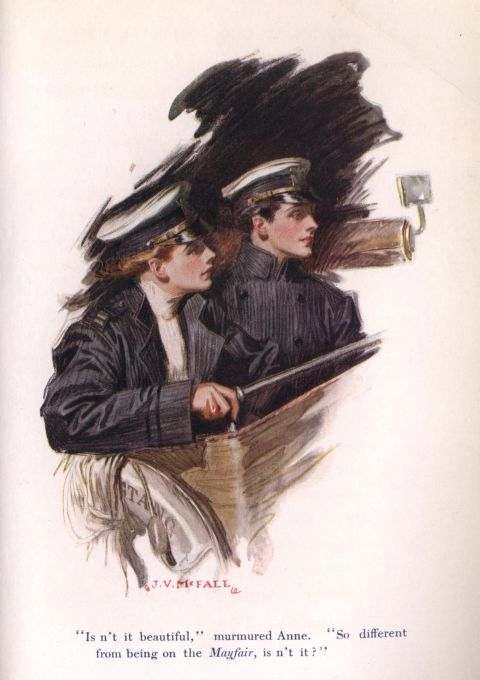 "Isn't it beautiful," murmured Anne. "So different from being on the Mayfair, isn't it?"
Sara nodded.
"So much more fun," she replied. "Much more thrilling."
As a matter of fact, the atmosphere of expectancy filled the vessel. Armitage, concerned with the navigation of the ship, his cap reversed to keep the wind from getting under the peak and lifting it into the sea, had neglected them utterly, and the junior had not withdrawn his head from the chart booth for half an hour.
Time and again Jack's face swept past, unseeing them, toward the quartermaster with hands on the wheel, at the rear of the bridge, crying crisply:
"Helm to port."
And the quartermaster replied as he twisted the wheel:
"Helm to port, sir."
Then--
"Ease your helm!"
"Ease your helm, sir."
The dark had fallen now. Ahead the Point Judith acetylene buoy sent its rays toward them. When they came abreast of it, it was pitch black and the white light on Watch Hill was made out to the southeastward. Suddenly from the Jefferson's deck a series of red and white lights began to wink and blink. Answering signals twinkled over a mile of water and the boats stopped their engines, rolling like logs on the waters.
Armitage walked over to Anne and Sara, who, in their coats and caps, looked not unlike officers themselves.
"How do you like it?"
"Oh, it is terribly interesting!" said Anne. "What are you going to do now?"
"Wait for the battleships, I imagine," said Armitage. "We don't really torpedo them," he added. "The object is to get as close as possible without being observed. They try to locate us with searchlights. As soon as they see us they put the light on us and fire a red star. After that star is fired the discovered boat must steam full speed for the quarry for one minute and then fire a green star and turn on her lights. The distance from the battleship to the boat is measured and if we are within torpedo range, two thousand yards, the torpedo boat wins. If the distance is greater, we are technically out of action--the battleship wins."
"How interesting!" Anne gazed at Armitage admiringly. "And that is what you would do in real warfare then--rush into the very face of the battleship's firing in the effort to blow her up?"
"About that," smiled Armitage.
"But what a risk! You must steam through a perfect hail of bullets, with chances of striking with your torpedo largely against you. And even if you do strike you are liable to pay the price with your lives. Am I not right?"
"These pirates of the flotilla," laughed Jack, "do not think of the price. They 're in the Navy to think of other things."
"And is that the spirit of the American Navy?"
"Of course," Armitage looked at her curiously. "Why not?"
Anne laughed and shrugged her shoulders.
"Oh, I don't know. I know something of the British and French Navies, but patriotism--the sort of spirit you speak of--has always appeared to me such an abstract thing as regards America. It's because, I suppose, I have never known anything about it, because I have been more or less of an expatriate all my life."
Jack had been watching a display of Ardois lights from the Jefferson's mast. He turned away, but spoke over his shoulder.
"Don't be that, Miss Wellington, for you have proved to me that a girl or a child, reared as you have been, can be American in every instinct and action. I had never believed that."
He hurried away to the bridge rail and Anne's arm turned red under the impress of Sara's fingers.
In compliance with the Jefferson's signals, the engines of the flotilla began to throb and the boats turned to the eastward.
A cry came from the D'Estang's lookout. Anne and Sara leaned forward and saw that a blundering sailing vessel--her dark sails a blotch against the sky, her hull invisible--was careening just ahead. She had no lights, and curses on the heads of coastwise skippers who take risks and place other vessels in jeopardy merely to save oil, swept through the flotilla like ether waves.
Armitage let a good Anglo-Saxon objurgation slip from his tongue as he turned toward the yeoman.
"Half speed!"
"Half speed, sir," answered the yeoman as he tugged at the engine room telegraph.
All eyes were now on the schooner. How was she heading? A group of seamen stood beside Armitage and Johnson on the bridge, trying to ascertain that important point. A flash of lightning gave a momentary glance of greasy sails bulged to port.
"She 's on the starboard tack, crossing the flotilla!"
"All right." There was relief in Jack's voice as he called for full speed ahead.
"It's no fun to ram a merchantman, with all the law you get into," said the signal quartermaster, standing near the young women. "And if they hit you, good-bye."
But the schooner had a knowing captain. He had no intention of trying to cross all those sharp bows. He quickly tacked between the D'Estang and Barclay and passed the rest of the boats astern.
Slowly the boats were loafing along now.
At ten-thirty the Jefferson winked her signals at the rest of the flotilla.
"Put out all lights."
As the young women glanced over the sea the truck lights died responsively. Then the green and red starboard and port lamps and lights in wardroom and galley went out and men hurried along the deck placing tarpaulins over the engine room gratings. Only the binnacle lights remained and these were muffled with just a crack for the helmsman to peer through.
A great blackness settled over the waters. To Anne, always an impressionable girl, it was as though all life had suddenly been obliterated from the face of them. Her hand tightened its grasp on Sara's fingers, for as the vessel plunged along there was a palpable impression that the flotilla, now hurrying forward in viewless haste, was pitched for the supreme test. Off to the seaward signal lights from the parent ship Racine, having on board the officer in charge of the Navy's mobile defences--which is to say, torpedo boats--had flared and died. The battleships were approaching.
Anne, quivering with excitement, peered out through the night; nothing but darkness. Below, lined along the rails, she caught dull outlines of the white caps of the seamen, all as eager to defeat the battleships as their officers. She saw the phosphorescent gleam from a shattered wave. But she heard nothing, not even the swish of water.
Johnson approached diffidently, and leaned over the rail at their side, straining his eyes into the night.
"The chances of making a successful attack," he said, "are best if we approach from almost ahead, a little on the bow. Then we are lessening the distance between us at the sum of the speeds of the flotilla and the battleships. We'll hit up about twenty-five knots when we see them. Of--"
A low incisive voice sounded forward, a blotch of a hand and arm pointing. There was a movement on the bridge as a dark object came close. It was the Jefferson. A dull figure leaned over her bridge with a megaphone.
"We've blown out some boiler tubes and scalded a couple of men, D'Estang. Go in ahead."
"All right," Jack's voice was muffled.
Again came the voice of the lookout and the arm pointed ahead.
"Oh!" Anne pinched Sara's arm. "I see them. See those great black shadows over there?" She stepped forward. "Shall I tell them?"
But Armitage had seen. He turned to the yeoman.
"Full speed, ahead!"
"Full speed, ahead, sir."
The slender hull throbbed with the giant pulsings of the two sets of engines. There was not another sound. It was as though the vessel were plunging through an endless void. In the darkness astern arose a spear-like puff of crimson flame. Again it appeared and again, quivering, sinister.
"Damn the Barclay; she's torching!" There came a shout from out of the dark and in an instant two great beams of lambent light cut wide swaths through the pall. They were too high; they missed the D'Estang altogether and rested on the Barclay's smoke, which rose and tumbled and billowed and writhed like a heavy shroud in the ghastly shafts.
"They've missed us and are trying to get the Barclay. Come on!" Jack's voice was vibrant with the joy of the test. He was kneeling on the bridge, a megaphone in his hand. He turned it toward the women. "Crouch down beside that gun and stay down, please, until this is over."
As he spoke, the leading battleship, the dreadnaught Arizona, was getting her searchlight beams down, and all unseen, the D'Estang and she were approaching each other at a total speed of thirty-seven knots.
Nearer they came and the destroyer was almost to the great dark blur, with the shining arms radiating from her like living tails from a dead comet, when, with terrible suddenness and intensity almost burning, the Arizona flashed a sixty-inch searchlight directly down on the destroyer's bridge. Sara stifled a scream and Anne bowed her head to the deck to shut out the fearful blaze. Armitage, standing upright now and rubbing open his eyes, saw that the time had come to turn, and quickly. The D'Estang was approaching the battleship, pointing toward her port bow. The idea of the manoeuvre was to turn in a semicircle, passing the Arizona at a distance of about two hundred yards. He shouted the order.
"Hard--a--port."
There was an instant's silence and the face of the quartermaster was seen to turn pale in the glare of the relentless searchlight.
"Wheel rope carried away, sir."
Armitage fairly threw himself across the bridge, but Johnson was there first. Quiet, unemotional Johnson, his hat off now, his hair dishevelled, and his eyes blazing.
"The helm is jambed hard a-starboard!" he cried.
In an instant the situation crystallized itself into a flashing picture upon Anne's mind. She had held the wheel on her father's yacht; but it was not that which made her see. It was divination, which fear or danger sometimes brings to highly sensitized minds--just as it brought the same picture to Sara's mind. With helm thus jambed, it meant that the D'Estang would have to turn in the same direction in which the Arizona was ploughing along at a twelve-knot speed. In making this turn she could not possibly clear, but must strike the battleship. On the other hand she was too near to be stopped in time to avoid going across the bows of that great plunging mass of drab steel, and being cut in two.
Anne, crouching immovable, her eyes fixed on Armitage, saw his head half turn in her direction, then with the automatic movement of a machine, he reached for the port engine room telegraph and with a jerk threw the port engine full speed astern. The bridge quivered as though it were being torn from its place; throughout the hull sounded a great metallic clanking. There came a new motion. The destroyer was spinning like a top, the bow almost at a standstill, the stem swinging in a great arc.
It was like the working out of a problem in dynamics. Nearer they came. Anne could now make out the great shape of the battleship; the dull funnels belching black clouds of smoke, which, merging with the night, were immediately absorbed; the shadowy, basket-like masts, from which the search-light rays went forth; the long, vaguely protruding twelve-inch guns. A whistle, tremulous and piercing, shrilled along the battleship's deck; dull white figures were clambering into the port life boats. Still closer now! Anne could hear the heavy swish of waters under the Arizona's bows. Her nerves were tight strung, prepared for the crash of steel against steel and the shock of the submersion. There was no sound from the Arizona now. Her bridge had echoed with shouts of warning. The time for that had passed. Armitage had not uttered a sound. Straight he stood by the telegraph, tense and rigid, his hand clutching the lever.
Around came the stern with fearful momentum, so close--but clear of the giant hull--that the gunner's mate at the stern torpedo tube took his chew of tobacco and, as he afterwards put it, "torpedoed the battleship with his eyes shut." Now the stern was pointed directly toward the Arizona, hardly five yards away. Armitage, bending over the telegraph, jerked sharply upon the lever, throwing the port engine full speed ahead again. He stood up and glanced quickly astern. Like a live thing, the D'Estang jumped clear. Sara leaned heavily on Anne's shoulder with little tearless sobs. But Anne, crouching in the position she had maintained since the search-light had blinded the bridge, still watched Jack with eyes that seemed to transfix him.
A figure leaped to the end of the battleship's bridge.
"The Admiral's compliments, D'Estang;"
The engines were stopped now and Armitage and Johnson and a group of men were working at the helm. Sara raised her head.
"Anne," she said solemnly. "I never wanted to kiss a man until this minute." Mischievously she made a move as though to arise. The girl's hand clenched upon her arm.
"Don't be an idiot," she said. "Can't you see how busy they are? Besides, Sara, no man likes to be kissed by two girls--at the same time."
As Jack, once more a chauffeur, drove under the porte cochère at The Crags, shortly before one o'clock, Anne sat for a moment in her seat after her friend had alighted. Sara looked back with a little smile and then walked toward the door, which a footman had opened.
"Mr. Armitage," said Anne in a low voice, "I want to thank you for many things to-night--for one thing above all. I cannot tell you what it is, for I hardly know myself." She paused, and Jack, who was toying with the switch lever, looked at her curiously. "It's a new viewpoint, I fancy. Somehow--I have a feeling that there is more to this country, my country, than Fifth Avenue, Central Park, Tuxedo, Long Island, and Newport--something bigger and finer than railroads. I am glad to feel that, and I thank you."