22. The Ball Begins
Mrs. Wellington's genius for organization was never better exemplified than next day, when preparations for the ball set for the night, began. At the outset it was perfectly apparent that she was not bent on breaking records--which feat, as a matter of fact, would merely have been overshadowing her best previous demonstrations of supremacy in things of this sort. There was to be no splurge. With a high European nobleman to introduce, she had no intention of having the protagonist in the evening's function overshadowed by his background. She was a student of social nuances--say rather, a master in this subtle art, and she proceeded with her plans with all the calm assurance of a field marshal with a dozen successful campaigns behind him.
Early in the day, Dawson and Buchan and Mrs. Stetson were in conference with her in her office and a bit later the servants, some thirty or forty of them, were assembled in their dining-room and assigned various duties, all of which were performed under the supervising eye of Mrs. Wellington, her daughter, or Sara Van Valkenberg. No decorative specialist, or other alien appendage to social functions on a large scale, was in attendance, and, save for the caterer's men, who arranged a hundred odd small tables on the verandas, and the electricians, who hung chandeliers at intervals above them, the arrangements were carried out by the household force.
Under the direction of Anne Wellington--whose mind seemed fully occupied with the manifold details of the duties which her mother had assigned to her--Armitage and a small group hung tapestries against the side of the house where the tables were, and then assisted the gardener and his staff in placing gladiolas about the globes of the chandeliers. Small incandescent globes of divers colors were hidden among the flowers in the gardens and an elaborate scheme of interior floral decoration was carried out. Before the afternoon was well along, all preparations had been completed and the women had gone to their rooms, where later they were served by their maids with light suppers. Armitage went to town in the car to meet the Prince, whom he had taken from The Crags at the unusually early hour of nine o'clock, and incidentally to pick up his evening clothes, which Thornton, in accordance with telephoned instructions, had left with the marine guard at the Government ferry house.
For Mrs. Wellington, whose sardonic sense of humor had not been lost in the rush of affairs, had assigned him to detective duty for the evening's function.
"McCall," she had said, "I want you to disguise yourself as a gentleman to-night and assist Chief Roberts's man in protecting the house from gentry who at times manage to gain access to the upper floors in the course of affairs of this sort. Evening dress will do--at least it is usually regarded as a good disguise, I believe."
He had received his orders, despite the sarcastic verbiage in which they were couched, with glowing emotions not easily concealed; they fitted perfectly with his preconceived determination to bring to a conclusion that night, once and for all, the situation which had brought him to The Crags.
He had, in short, resolved, come what might, to ransack Koltsoff's rooms before dawn--to dump the contents of all drawers in the middle of the floors, to cut with his knife any bags that might be locked, and in general to turn the suite inside out. For he had come to the conclusion that every one, save possibly Prince Koltsoff and the horses and dogs, knew whom he really was, and that being the case, further masquerading was nothing short of intolerable.
Then, too, yesterday's talk with Anne Wellington in Lover's Lane was running through his mind like a thread of gold, and clearly the time had come, either to meet her with identity unclouded in the minds of all, or go away and never see her again. As to the last--that depended on several things: upon second thought, upon one thing, upon Anne Wellington herself. Throughout the day in her various meetings with him, she had been markedly impersonal, tacit intimation that from now on so long as he cared to pose as an employee of the house, he must accept all the accruing conditions. He understood her position, of course, and as for his--well, he would attend to it that very night.
He found his bag waiting for him at the ferry and Prince Koltsoff at the designated place, the Reading Room. The Russian had not worked out of his irritation, not to say alarm, at the unaccountable disappearance of his chief lieutenant, but found some comfort in the fact that agents of the St. Petersburg State Department were already buzzing about Washington and Boston in regard to the matter of the Austrian mobilization plans. Armitage found him in a dogged, determined mood. He, too, was facing a situation which he meant to end that night, and his plans were all matured.
He went to his room, spent an hour or so dictating to his secretary, instructed him to call up the White Star Line in New York and book him for Friday, and then went down to the billiard room, where the men were engrossed in a close game between Marie and Willie Whipple. From here he wandered to the smoking apartment, which had begun to resemble the sample room of a wholesale liquor house. He had a servant pour him some Scotch whiskey, over which he sat for some time with thoughtful eyes, half closed. A growing uneasiness, which he could neither define nor overcome, crept over him and at length he arose and passed through the library, the morning-room, the drawing-room, even peering into the ballroom in his search for Miss Wellington. Miss Hatch was just emerging and the Prince eyed her in a peremptory way.
"Miss Wellington is not about?" he said, raising his eyebrows.
"Is not about," said Miss Hatch, who hurried away with her short, nervous steps before Koltsoff had opportunity for questioning her further.
He glared at her retreating form and was about to follow her, when Mr. Wellington interposed.
"Hello, Koltsoff," he said, "come and have a bite with us before you go upstairs. We missed you in the billiard room."
Koltsoff bowed ceremoniously.
"Thank you, but no," he replied. "I have eaten a sandwich or so in the smoking-room. If you will permit, I shall retire until the,--ah, ball."
"All right. By the way, Koltsoff, you have seemed off your feed for the past twenty-four hours. I am sorry if I upset you. You, of course, were sensible to see my position."
"Oh, perfectly," responded the Russian with an ill-concealed sneer--in fact, it was not concealed at all--as he turned toward the stairway.
When Armitage took up his position near the head of the stairs about nine-thirty o'clock, the house was ablaze with lights, but the lower floors were deserted, save for the servants loitering about the hall. These men, all in the Wellington livery--short jackets and trousers of navy blue, with old gold cord--impressed Jack, inasmuch as they suggested in some way a sense of belonging to the household, which they did naturally, and not as servants merely engaged--or loaned--for the function. Mrs. Wellington and her husband came down at ten o'clock and took a position near the ballroom door, just as a group of early arrivals trouped up the stairs. Armitage didn't approve of Mrs. Wellington. In her creamy ball gown and tiara and jewels, she was majestic and imperious to a stunning degree, but to the young naval officer--or shall we say detective--she suggested for the first time the distinction of caste. The immeasurable distance created by the millions of dollars and the social prestige of Belle Wellington and those like her, served to set them aloof from their countrymen and countrywomen. As she walked along at the side of her hulking husband she seemed the very embodiment of the aloofness of her caste. Heretofore, Jack had regarded her as a distinctly interesting, remarkably well-preserved, middle-aged gentlewoman of striking mentality, a woman whom he could like and enjoy. To-night, he admitted, she inspired in him nothing but emotions of fear.
Mentally, he fortified himself against the appearance of Anne Wellington, who, in truth, merited this precaution as she stepped past him with a slight nod and went down the stairs. She was not a bit overdone--Jack admitted that at once--and yet, how different she was from the girl in the shirtwaist suit and black hat, whom he had seen entering the sight-seeing barge the previous day, or who swathed in his navy coat, his hat pushed down over her eyes, had stood with him on the bridge of the D'Estang; She was all in white, slim, supple, without jewelry, save for a string of pearls about her neck. A light, filmy veil was thrown across her bare shoulders and the living curls and waves of her flawless coiffure gleamed as they caught the lights of the chandeliers. And yet--! The girlishness which Jack had found so attractive in her, was missing, and so was the characteristic animation of her features. Instead, her face was set in a formal, politely interested expression, which to Armitage seemed to change her entire personality. Yesterday she was radiant, light-hearted, impulsive, and thoroughly lovable. To-night, she was, so to say, a professional beauty, "rigged and trigged" for competition; one of a set whose ambitions, apparently, coveted no triumphs more exalted than those to be gained here, who rated artificiality as a fine art and appraised life upon the basis of standards which even the casual observer would hardly pronounce either moral or exalted.
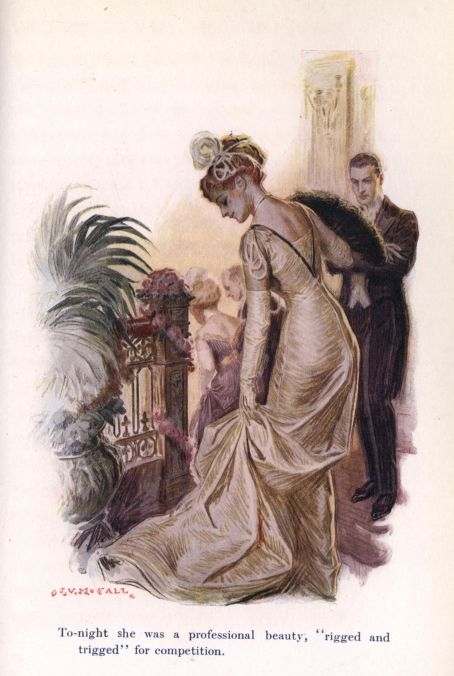 To-night she was a professional beauty, "rigged and trigged" for competition.
As Armitage followed her graceful course to the side of her parents, he groaned, half humorously, and then went wandering about the upper hallway, a prey to conflicting emotions, engendered by the new point of view which the girl had unconsciously presented. A couplet of Browning's was running through his mind and more than once he found himself muttering the words:
"Oh, the little more and how much it is,
And the little less and what worlds away."
True! What worlds away she was to-night! Not that he had any sense of social inferiority,--he was too proud of his family for that,--but utterly alien to him and his thoughts and ideals and aspirations, she seemed. He wondered at the foolhardiness which hitherto had characterized his attitude toward her, and at the same time called himself hard names for it. Why, she was unapproachable with all her beauty and millions and methods of life! What had he been thinking of--dreaming of? His face hardened. It was not too late to cease playing the part of a fool and an ass. He would accomplish what he had come there to do and then clear out, which sensible act, he trusted, might at least serve to mitigate to some extent the opinion she must have formulated concerning him. She had had her fun, had studied and analyzed him as far as he intended she should. She might have her laugh and enjoy it to the full, but she was not to have the opportunity of laughing in his face. He went to his room, packed his bag, and then going down the rear stairway, took it out the servants' door and laid it under the hydrangeas near the main gate. When he returned, the guests were beginning to come down stairs. All his inward ease had departed. He was tense, cleared for action. All of which shows how far the emotions of an ardent nature are apt to lead a young man astray--as he was to learn before this ball was at an end.
In the meantime he followed the sights and sounds with no great interest. He was vaguely amused at the remark of a woman beyond the first bloom of youth, who, turning to her companion and nodding toward a socially famous young matron, who preceded them down the stairs fairly jingling with jewelry, remarked:
"I say, Jerry, Mrs. Billy has put on everything but the kitchen stove."
It confirmed in Jack's mind an impression which had begun to form, that the smart set, so-called, is not altogether lacking in, well,--smartness.
When the Prince entered with a ribbon and orders across his breast, the orchestra played the Russian national anthem, whereat every one arose and stood at attention. Jack noticed, however, that attention ceased and almost every one sat down during the rendering of "The Star Spangled Banner," which followed. This, he decided, might have been because no one heard it in the confusion of voices which attended the closing strains of the Russian hymn and Koltsoff's course about the room. Armitage particularly looked for Anne and located her at the Prince's side, the centre of a vivacious group. Evidently the orchestra might as well have been playing a selection from "Madame Butterfly," so far as she was concerned. This didn't help his mood and after waiting for the first dance, a quadrille in which even the elderly participated--it was given so they might--he sauntered out on the veranda and stood there gazing vacantly at the glowing parterre and smoking a cigarette.