9. Upheaval
"Forty-eight, forty-nine, fifty, fifty-one, fifty-two, fifty-three,--for goodness' sake!--fifty-four, fifty-five." Carol looked helplessly at her dusty hands and mopped her face desperately with her forearm.
David, watching her from the bed in the adjoining room, gave way to silent laughter, and she resumed her solemn count.
"Forty-six, forty--"
"Fifty-six," he called. "Don't try any trickery on me."
"Fifty-six, fifty-seven, fifty-eight, fifty-nine, sixty." She sighed audibly. "Sixty-one, sixty-two, sixty-three, sixty-four--sixty-four perfectly fresh eggs," she announced, turning to the doorway and frowning at her husband, who still laughed. "Sixty-four perfectly fresh eggs, all laid yesterday."
"Now, I give you fair warning, my dear, I am no cold storage plant, and you can't make me absorb any sixty-four egg-nogs daily just to even up the demand with the supply. I drank seven yesterday, but this is too much. You must seek another warehouse."
"You are very clever and facetious, Davie, really quite entertaining. But what am I to do with sixty-four fresh eggs?"
"And I may as well confess frankly that I consider a minister's wife distinctly out of her sphere when she tries to corner the fresh egg market, particularly at the present price of existence. It isn't scriptural. It isn't orthodox. I am surprised at you, Carol. It must be some more Methodism cropping out. I never knew a Presbyterian to do it."
"And as for milk--"
"There you go again,--milk. Worse and worse. Yesterday I had milk toast, and milk custard, and fresh milk, and buttermilk. And here you come at me again first thing to-day. Milk!"
"Seven whole quarts have arrived this morning,--bless their darling old hearts."
"The cows?"
"The parishioners," Carol explained patiently. "Ever since the doctor said fresh milk and eggs, we've been flooded with milk and--"
"Pelted with eggs. But you can't pelt any sixty-four eggs down me."
"David," she said reproachfully, "I must confess that you don't sound very sick. The doctor says, 'Take him west,' and I am taking you if I ever get rid of these eggs. But I do think it would be more appropriate to take you to a vaudeville show where you might coin some of this extravagant humor. There's a market for it, you know."
"Here comes Mrs. Sater, with a covered basket," announced David, glancing from the window. "I just wonder if the dear kind woman is bringing me a few fresh eggs. You know the doctor advised me to eat fresh eggs, and--"
Carol clutched her curly head in despair. "Cock-a-doodle-doo," she crowed.
"You mean, 'Cut-cut-cut-ca-duck-et,'" reproved David.
Mrs. Sater paused outside the manse door in blank astonishment. Dear, precious David so terribly ill, and poor little Carol getting ready to take him away to a strange and awful country, and the world full of sadness and weeping and gnashing of teeth, and yet--from the open windows of the manse came the clear ring of Carol's laughter, followed closely by David's deeper voice. What in the world was there to laugh at, since tuberculosis had rapped at the manse door?
They were young, of course, and they were still in love,--that helped. And they had the deathless courage of the young and loving. But Mrs. Sater bet a dollar she wouldn't waste any time laughing if tuberculosis were stalking through her home.
"Come in," said Carol, in answer to her second ring. "We saw you from the window, but I was laughing so I was ashamed to open the door. David's so silly, Mrs. Sater. Since he isn't obliged to strain his mental capacity by thinking up sermons, he has developed quite a funny streak. Oh, did you bring us some nice fresh eggs? How dear of you. Yes, the doctor said he must eat lots of them."
"They were just laid yesterday," said Mrs. Sater complacently. "And I said to myself, 'Nice fresh eggs like these are too good for anybody less than a preacher.' So I brought them. There's just half a dozen,--he ought to eat that many in one day."
"Oh, yes, easily. He is very fond of egg-nog."
David sputtered feebly among the pillows. "Oh, easily," he echoed helplessly.
"I knew a woman that ate eighteen eggs every day," said Mrs. Sater encouragingly. "She got well and weighed two hundred and thirty pounds, and then she had apoplexy and died."
David turned on Carol reproachfully. "There you see! That's what comes of eating raw eggs." Then he added suspiciously, "Maybe you knew it before and have been enticing me to raw eggs on purpose."
Both Carol and David seized this silly pretext to relieve their feelings, and laughed so heartily that good Mrs. Sater was quite concerned for them. She had heard it sometimes affected folks like that,--a great nervous or mental shock. She looked at them very anxiously indeed.
"Are you selling your furniture pretty well?" she asked nervously.
"Oh, just fine. Mr. Barker at the drug store has promised to fumigate everything after we are gone, so we won't scatter any germs in our wake." Carol spoke hurriedly, her heart swelling with pity as she saw the sudden convulsive clutching of David's hands beneath the covers. "Mr. Daniels has a list of 'who bought what,' and will see that everything is delivered in good shape. Only, we take the money ourselves in advance. Now look at this chair, Mrs. Sater,--a lovely chair," she rattled, thinking wretchedly of that contraction of David's hands and the darkening of his eyes. "A splendid chair. It isn't sold yet. It cost us eight seventy-five one year ago, and we are selling it for the mere pittance of five dollars even,--we make it even because we haven't any change. A most beautiful chair, an article to grace any home, a constant reminder of us, a chair in which great men have sat,--Mr. Daniels, and Mr. Baldwin, and the horrible gas collector who has made life wretched for every one in the Heights, and--all for five dollars, Mrs. Sater. Can you resist it?"
Carol's voice took on a new ring as she saw the shadow leave David's eyes, and his lips curve into laughter again.
"Well, I swan, Mrs. Duke, if you don't beat all. Yes, I'll take that chair. It may not be worth five dollars, but you are."
Carol ostentatiously collected the five dollars, doubled it carefully into a tiny bit, and tied it in the corner of her handkerchief.
"My money, Mr. David Arnold Duke, and I shall buy candy and talcum with it."
Then she ran into the adjoining room to answer the telephone.
Mrs. Sater looked about her hesitatingly and leaned forward.
"David," she said in a low voice, "Carol ought to go home to her father. It's dangerous for her to stay with you. Everybody says so. Make her go home until you are well. She may get it too if she goes along. They'll take good care of you at the Presbyterian hospital out there, you a minister and all."
The laughter, the light, left David's face at the first word.
"I know it," he said in a heavy voice. "I have told her to go home. But she won't even talk it over. She gets angry if I mention it. Every one tells me it is dangerous,--but Carol won't listen."
"Just until you get well, you know."
"I shall never get well unless she is with me. But I am trying to send her away. What can I do? I can't drive her off." His hands closed and then relaxed, lying helplessly on the covers.
When Carol returned she looked suspiciously from the stern white face on the pillow to the disturbed one of her caller.
"David is tired, Mrs. Sater," she said gently. "Let's go out in the other room and visit. I have made him laugh too much to-day, and he is weak. Come along and maybe I can sell you some more furniture." Then to David, brightly, "It was Mrs. Adams, David, she wanted to know if we needed any nice fresh eggs." She flashed a smile at him and his lips answered, but his eyes were mute. Carol looked back at him from the doorway, questioning, but finally followed Mrs. Sater into the next room.
"Mrs. Sater, you will excuse me now, won't you?" she said. "But I have a feeling that David needs me. He looks so tired. You will come in again, and--"
"Certainly, my dear, David first by all means. Run right along. And if you need any more fresh eggs, just let me know."
"Yes, thank you, yes."
"Carol," whispered the kindly woman earnestly, "why don't you go home and stay with your father until David is better? They will take such good care of him at the hospital, and he will need you when he is well, and it isn't safe, Carol, it positively is not safe. Why won't you do as he tells you?"
Carol stood up, very straight and very tall. "Mrs. Sater," she said, "you know I am an old-fashioned Methodist. And I believe that God wanted David to have me in his illness, when he is idle. If He hadn't, the illness would have come before our marriage. But I think God foresaw it coming and thought maybe I could do David good when he was laid aside. I know I am a silly little goose, but David loves me, and is happy when I am with him, and enjoys me more than anything else in the world. I am going with him. I know God expects me to do my part."
And Mrs. Sater went away, after kissing Carol's cheek, which already was paling a little with anxiety.
Carol ran back to David and sat on the floor beside him, pulling his hand from beneath the cover and kissing the white, blue-veined fingers. She crooned and gurgled over him as a mother over a little child, but did not speak until at last he turned to her and said abruptly:
"Carol, won't you go home until I get well? Please dear, for my sake."
Carol kissed the thumb once more and frowned at him. "You want to flirt with the nurses when you get out there, and are trying to get me out of the road. Every one says nurses are dangerous."
"Carol, please."
"Mrs. Sater has been talking to you. Oh, I knew it. She is a nice, kind, Christian woman, and loves us both, but, David, why doesn't God teach some people to mind their own business? She is a good Christian, I know, dear, but I do believe there is still a little work of grace to be done in her."
David smiled a little, sadly.
"Carol, it would break my heart if you got this from me."
"I won't get it. They will teach us how to be careful and sanitary, and take proper precautions, and things like that. I am going to be very, very careful. Why, honey, I won't get it. But, David, I would rather get it than go away and leave you. I couldn't do that. I should never be happy again if I left you when you were needing me."
David turned his face to the wall. "Maybe, dear," he said very gently, "maybe it would be better if you did go home,--better for me. I need perfect rest you know, and we talk and laugh so much and have such good times together. I don't know, possibly I might get well faster--alone."
For a long moment Carol gazed at him in horror. "David," she gasped. "Don't say that. Dear, I will go home if it makes you worse to have me. I will do anything. I only want to help you. But I will be very nice and quiet, like a mouse, and never say a word, and not laugh once, if you take me with you. David, do I make you feel sicker? Does my chatter weary you? I thought I was helping to amuse you."
"Carol, I can't lie like that even to send you away from me. Maybe I ought to, but I can't. Why, sweetheart, you are the only thing left in the world. You are the world to me now. Dear, I said it for your sake, not for mine, Carol, never for mine."
Slowly the smiles struggled through the anguish in her face, and she resumed her kissing of his fingers.
"Silly old goose," she murmured; "big old silly goose. Just because he's a preacher he wants to boss all the time. Can't boss me. I won't be bossed. I like to boss myself. I won't let my beautiful old David go off out there to flirt with the nurses and Indian girls and whoever else is out there. I should say not. I'll stick right along, and whenever a woman turns our way, I'll shout, 'Married! He is mine!'"
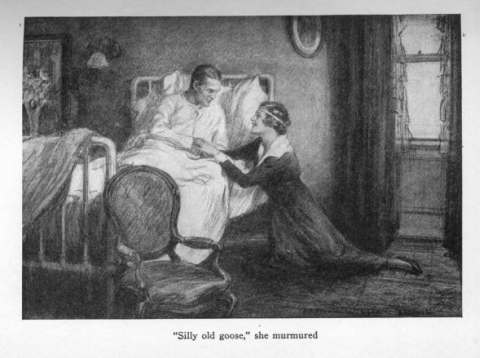 "Silly old goose," she murmured.
David laughed at her passionate discussion to herself.
"Besides, I have been learning a lot of things. I've been talking to the doctor privately when you couldn't hear."
"Indeed!"
"Oh, yes, and we are great friends. He says if we just live clean, white, sanitary lives, I am safe. I must keep strong and fat, and the germs can't get a start. And he has been telling me lots of nice things to do. David, I know I can help you. The doctor said so. He says I must be happy and gay, and be positively sure you will be well again in time, and I can do you more good than a tonic. Yes, he said that very thing, Doctor O'Hara did. Now please beg my pardon, and maybe I'll forgive you."
David promptly did, and peace was restored.
A committee of brotherly ministers was sent out from the Presbytery to find how things were going in the little manse in the Heights. Very gently, very tenderly they made their inquiries of Carol, and Carol answered frankly.
"With the furniture money we have six hundred dollars," she told them, rather proudly.
"That's just fine. It will take you to Albuquerque and keep you straight for a few months, and by that time we'll have things in hand back here. You know, Mrs. Duke, you and David belong to us and we are going to see you through. And then when it is all over we'll get him a church out there,--why, everything is going splendidly. Now remember, it may be a few months, or it may be ten years, but we are back of you and we are going to see you through. Don't ever wonder where next month's board is to come from. It will come. It isn't charity, Mrs. Duke. It is just the big brotherhood of the church, that's all. We are going to be your brothers, and fathers, and--mothers, too, if you will have us."
The devoted mansers rallied around them, weeping over them, giving them good advice along with other more material, but not more helpful, assistance and declaring they always knew David was too good to live. And when Carol resentfully assured them that David was still very much alive, and maybe wasn't as good as they thought, they retaliated by suggesting that her life was in no danger on that score.
On the occasion of Doctor O'Hara's last visit, Carol followed him out to the porch.
"You haven't presented your bill," she reminded him. "And it's a good thing for you we are preachers or we might have slipped away in the night."
"I haven't any bill against you," he said, smiling kindly down at her.
Carol flushed. "Doctor," she protested. "We expected to pay you. We have the money. We don't want you to think we can't afford it. We knew you were an expensive doctor, but we wanted you anyhow."
He smiled again. "I know you have the money, but, my dear little girl, you are going to need every cent of it and more too before you get rid of this specter. But I couldn't charge David anything if he were a millionaire. Don't you understand,--this is the only way we doctors have of showing what we think of the big work these preachers are doing here and there around the country?"
"But, doctor," said Carol confusedly, "we are--Presbyterians, you know--we are Protestants."
The doctor laughed. "And I am a Catholic. But what is your point? David is doing good work, not my kind perhaps, and not my way, but I hope, my dear, we are big enough and broad enough to take off our hats to a good worker whether he does things just our way or not."
Carol looked abashed. She caught her under lip between her teeth and kept her eyes upon the floor for a moment. Finally she faced him bravely.
"I wasn't big or broad,--not even a little teensy bit," she said honestly. "I was a little, shut-in, self-centered goose. But I believe I am learning things now. You are grand," she said, holding out her slender hand.
The doctor took it in his. "Carol, don't forget to laugh when you get to Albuquerque. You will be sick, and sorry, and there will be sobs in your heart, and your soul will cry aloud, but--keep laughing, for David is going to need it."
Carol went directly to her husband.
"David, I am learning lots of perfectly wonderful things. If I live to be a thousand years old,--oh, David, I believe by that time I can love everybody on earth, and have sympathy for all and condemnation for none; and I will really know that nearly every one in the world is very good, and those that are not are pretty good."
David burst into laughter at her words. "Poorly expressed, but finely meant," he cried. "Are you trying to become the preacher in our family?"
"All packed up and ready to start," she said thoughtfully, "and to-morrow night we leave our darling little manse, and our precious old mansers and turn cowboy. Aren't you glad you didn't send me home?"