14. 1-14 Clouds Upon The Charm
"The burden of bright colours. Thou shalt see
Gold tarnished, and the grey above the green."
Swinburne.
After an evening of ecstasy such as Olwen had lived through upon those iridescent waves, what could the girl expect?
It is one of Fate's harshest rules that in one way or another we pay for our ecstasies. The more golden the moment the more dull and clouded must seem the hours that follow: and that is just because we have seen that magic green shimmer on the breaker's crest that the grey of these smooth waters looks to us so leaden. Ah, better to know the sadness of this than never to have set keel in any but the quiet waters! To have no reckoning to pay because no ecstasy has been ours to enjoy is surely the bitterest price that can be demanded of us.... But Olwen was too young to recognize this.
So, when the next day she emerged bit by bit from her dream, she was sore and resentful to find all life at its flattest.
To begin with (and, indeed, to go on with; for this was the whole leaven of discontent), Captain Ross encountered her as if there had been no magic voyage, no hand clasped in hand, no wildfire, no silent thrills between them. "Ah, good morrrrning, Miss Howel-Jones. Another beautiful day----"
Beautiful, indeed.... Olwen felt as if by rights the sun should have gone out and the rains should have come to weep over the lagoon. As a matter of fact the weather remained radiant. Her idol's easy, friendly manner had dealt her a blow that stunned her into a torper of low spirits, and there seemed nobody to give her a helping hand out of it.
Mrs. Cartwright, usually so sympathetic and interesting, talked to her (Olwen) as if her thoughts were far, far away: with her serial-people, the girl supposed vexedly, or with those boys of hers at school.
Young Mr. Awdas--well, he never talked to Olwen. An apathetic young man, she considered him. All flyers were interesting from their very job--otherwise how uninteresting was Mr. Awdas! Nobody but Mrs. Cartwright (who was so kind), would bother to draw him out, Olwen thought.
Then Agatha Walsh--impossible to talk to her today: her Sergeant Gustave Tronchet's leave was up, and he was to depart to join his battery that evening. They could not be married until his next leave. Poor Agatha was paying too for her golden moments.
Mr. Brown--well, as for Mr. Brown (who had, after all, done all the work in that boat the night before), Olwen felt that she could have slapped him. Upon Mr. Brown's well-meaning bullet head she felt herself pouring the resentment that she might have reserved for Captain Ross and his forgetfulness, his insensibility. Silly little Mr. Brown! Why on earth couldn't he run away and attract somebody (hadn't Olwen given him a talisman for that very purpose?) instead of hanging about trying to talk to somebody who was already distracted enough as it was, because her own talisman seemed sometimes so potent, sometimes so useless? That it should have allured Mr. Brown into being sentimental about her seemed the last straw! (to Olwen.)
But it wasn't. For it was Professor Howel-Jones, it was her Uncle himself who contributed to his niece's burden, on this day of depression, what was really the last straw.
It happened as Olwen brought to him, with a little air of triumph, the typed copy and the duplicate of the last section of the last chapter of his book on "Agarics."
"So that's finished," she said.
"That's finished," agreed the Professor, his brown gaze running over the sheets. "Olwen, I've done well here. This has been an excellent place for work; excellent." He laid the copy down on that chaotic work-table of his, and added, with cheerfulness, "Well! There's nothing to keep us here any longer, now."
This Olwen did not take in at once. "Nothing to keep us, Uncle?"
"Only the passports to be visé'd and made out for Paris," returned the old man. "I want to stay a night or so in Paris before I go on to London."
A great blankness fell upon Olwen's small face. "The passports," she repeated. "Paris!!! You mean you want us to leave quite soon?"
The Professor's head was bent over his work-table. "A couple of days, my dear, I suppose. You can be packed up and all that by then. You are broken in by now, aren't you, to your packing up and getting on without much warning?"
But this had taken Olwen without any warning, it appeared.
She stood there as if frozen, and said, "Away from here!" and in her heart exclaimed, "Away from him;" She stood aghast, an image of all the maids in love who have ever been sentenced to banishment from the presence of the beloved. She had put away from her up to now all thought of such a dreadful thing happening. Simply, she could not have imagined it. Going away from the hotel in the pine forest, while he still was left in it! Going away, before he had ever said to her a word that counted? Going away--with that Charm unproved?
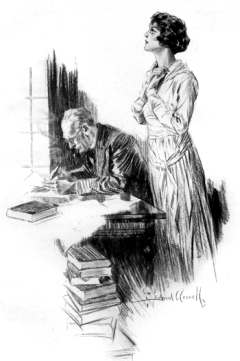 She stood there as if frozen, and said: "Away from here!" and in her heart exclaimed: "Away from him!"
It was time the Charm required; Olwen was agitatedly certain of that now. Time.
It had taken so many days before he had even held her hand; given so many other days, and what might not happen? But she was not to know. Those days were not to be allowed to her. She clenched into her palm the nails of those little fingers that Captain Ross had held in that warmly-caressing clasp. She was to go ... never to see him any more....
She cleared her throat, pulled herself together, and asked, "And after Paris, Uncle, where do we go; London, you said?"
Now, this was a gleam of hope; London!
For she had once heard Captain Ross, in talking to Mrs. Cartwright, tell the writer that when his sick leave was up and after he had been boarded, he had prospects of an office job in town. If he were in London, and if her Uncle and she were also in London ... well, then the outlook would not be entirely so black. It would not be the every day and several times a day encountering of this French hotel; but there surely might be meetings, if they were together, in London?
But the Professor, eyes still upon his papers, said, "London for a week or so, but I'm always glad enough to get out of the place. I shall be going down to Wales, then; I can leave you at your Auntie Margaret's, dear, before I go on to Liverpool. My plans will be unsettled----"
"You're not going to have me with you, then Uncle?"
"No, Olwen fach. For the present, not," he told her above the rustling of the papers. "I shan't require you for the work in hand for the next----Let me see, four or six months, perhaps. You will be able to go home; have a nice rest from work; help your Auntie in the house, see a little bit of your sisters and of your old friends."
Olwen felt precisely as if the genial-voiced old man were condemning her to penal servitude for the rest of her natural life.
"Uncle!" she exclaimed in horror.
It was met by a mildly surprised glance from the old man.
"What's the matter, small lass? Aren't you glad to be seeing your home again?"
"No," blurted out Olwen. "I don't want to go. Oh, I don't. Uncle! I'd rather be with you. Much. But if you can't have me, I--I--I won't go back----"
She put up her little head, shaking it violently as if in the face of a vision of the home in which she'd been brought up. Comfortable, old-fashioned, rambling place that it was, set in wild beauty, and echoing with gay voices, it repelled her; it seemed to her a prison from which there would be no further escaping towards the Heart's Desire. At work as her Uncle's secretary, there still seemed chances of movement in her life, there still seemed possibilities.... But as a girl at home, she felt she would be chained and bound by a thousand chances against.
She told herself rebelliously, "Down there, I should never see him again! I won't go!"
Unconsciously her hands clasped themselves upon her breast, upon that slender talisman that she was wearing.
The old man regarded her, at a loss why the child should be agitated, she who had always seemed happy enough with her sisters at home.
"But, Olwen fach, if you don't go back, what do you want to do?"
"I want to stay on in London, Uncle!"
"In London--dear me--curious taste! Why? What could you do there?"
"I could do War work, like lots and lots--like every other girl!"
"Tut," retorted the Professor. Being a Welshman, he pronounced this word to rhyme with "foot." Being a man of his generation, he still disliked to think of any girl at work except domestically or for him.
"What d'you want to do that for, Olwen fach?"
To this question Olwen could hardly answer with the whole truth.
How many girls insist upon working in London because there, also, is working their particular Captain Ross?
Olwen's mind was set upon a plan.
She would think out the "hows" as soon as she left this place.
Only a couple more days in which the Charm might work for her, here!