3. Reforms In Foreign And Domestic Policy
The reader will have gathered from the preceding chapters that while the main object of the promoters of the Restoration was the destruction of the Shogunate and the revival of the Imperial regime, they had utilised the cry of " expel the barbarian," in order to cement in one common bond of union all the fighting forces of the Empire not bound to the Tokugawa cause by ties of consanguinity or material interest. They had encouraged the fanatics who abounded everywhere in the exercise of their hatred to the foreigner, seeing how much it contributed to the complications of the sorely-harassed Shogunate in its last years. The late Emjjeror had, in formal rescripts, conveyed his unqualified approval to the Satsuraa and Choshiu fiefs, when they fought against the fleets of Great Britain and the allied Powers, and public sentiment had no less approved of the deeds of the many assassins by whom unofiending Europeans were over and over again cruelly and savagely murdered. Twice, almost in the very heart of the Shogun's capital, the British Legation was attacked at night by large bands of armed samurai, with the avowed object of murdering all its inmates, and the assailants were regarded as devoted patriots by all their compeers. The officials of the Foreign Legations, the only foreigners who resided in Yedo, had all to be closely guarded both when within their Legations and when they ventured outside the walls, and so insecure was the position of all Europeans in Japan, that large garrisons of English and French troops were quartered by their governments in Yokohama to afford to the ti-aders resident there the protection which it was believed the Shogunate had not the power to secure.
All who had shared the anti-foreign sentiment and had fought for their beliefs, fondly believed that the moment the Emperor regained his own an anti-foreign campaign would be at once instituted under the Emperor's banner, and they were as ready to give their swords to it as they had been to the overthrow of the Shogun. But while the cry of " expel the foreigner " had been openly used to the very last, so long as the Shogun was a power to be feared, a change had during the last years of the struggle taken place in the minds of the leaders of the movement. The two most powerful fiefs who took an active part in it had received severe lessons of the consequences of indulging in armed resistance to European powers. Some of the courtiers had also imbibed more liberal sentiments, under the influence of the leaders of the fiefs, and there was a sufficiently influential body of capable men around the young Emperor to mould his opinions and to develop in his name, while he was still too young to take the direct personal control of state affairs which was his right, the policy that they now believed was essential to the future integrity and progress of Japan. This policy meant a complete subversal of all that they had hitherto openly advocated, but it was at once boldly and publicly adopted.
On the 8th of February, 1868, a nobleman of high rank in the Court delivered to the Diplomatic Representatives of the foreign powers a formal document bearing the sign manual of the Emperor and sealed with " The Seal of Great Japan " for transmission to their Governments, in which the Emperor announced his intention of thenceforward exercising supreme authority both in the internal and external affairs of the country and of substituting in the treaties his own title for that of the Tycoon. This was followed a week later by a public rescript in which it was proclaimed that " intercourse with foreign countries shall in future be carried on in accordance with the public law of the whole world," and, as a first onward step on this path, an invitation soon followed to the Representatives to visit Kioto and be received in audience by His Majesty.
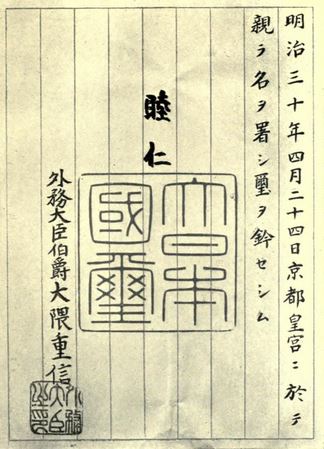 Sign Manual and Seal of the Emperor Mutsu Hito
 Kioto had been for more than a thousand years the sacred city of the Empire. It had been visited in the sixteenth and seventeenth centuries by the Jesuit missionaries, and Xavier and many of his disciples had openly preached the Christian doctrine in its streets. The Dutch traders had passed through it when on their way from Desima on their compulsory annual missions to the Shogun's court at Yedo. But neither had ever approached the palace or dreamt of audience with its holy occupant, and the Dutch always passed through the city closely guarded as though they were prisoners. Now the foreigners, who a very few years before had been publicly designated by the late Emperor as "Sea pirates," " Ugly Barbarians," and " Foul beasts," were not only to be admitted to the holy city but were to be received in person by the direct descendant of the Gods of Heaven ; they were to approach him erect and not humbly on their knees with foreheads touching the ground, and to gaze upon him with no intervening screen between him and them, such as had hitherto veiled his sacred person from the eyes even of the highest and noblest of his own people, even of the Great Lord, the Shogun, when at the very summit of his might and grandeur.
It is difficult even for a thinking Japanese of modern days to appreciate the significance of this event or to realise the profound impression which it created on those who had fought and schemed for the renewal of Japan's time-honoured seclusion. The ceremony was destined not to pass without its tragedy, one of the many which darkened those days of our intercourse with Japan. When Sir Harry Parkes, the British representative, who had been the first among his colleagues to recognise the new Government and to give it his strong moi-al support, was on his way to the palace, two fanatics, maddened at the desecration of the Emperor and of the city, suddenly attacked his English escort and inflicted severe wounds on ten of the men composing it, before they were themselves killed or disabled.
The audience had to be postponed till the following day, but the incident, unhappy and tragic as it was, was not without its good results. It gave the young Emperor, who was receiving Europeans for the first time, not only in his own life but in all the long history of his dynasty, and whose mind was no doubt full of curiosity, an opportunity for expressing, with the sympathetic tact and dignity which characterized him in after life, his regret at what had happened and of manifesting his desire to prevent its recurrence. Hitherto every samurai who murdered a European thought that he was putting his sword, his most treasured possession, to the noblest use he could make of it and that he was performing a service to his gods, his Emperor and his country. If he was brought to justice and had to pay the penalty of his act, both law and custom penuitted him to be his own executioner" and to find death in a way that brought no dishonour on either him or his relatives, which was in fact the consummation of martyrdom. An Imperial rescript was issued within a few day's ordering the nation : -
to obey His Majesty's will in the fulfilment of the Treaties with Foreign Countries in accordance with the rules of International Law,
and declaring that : -
all persons in future guilty of murdering foreigners or of committing acts of violence towards them will be acting in opposition to His Majesty's express orders and be the cause of national misfortune. They will therefore be punished in proportion to the gravity of their offence, and their names, if samurai, will be erased from the roll.
The last clause involved not only social degradation to the offender and his family, but a humiliating death to the former at the hands of the public executioner. Thenceforward the murderer of a foreigner lost the character of a martyr and became a common criminal like any robber or thief. From that day outrages of this nature entirely ceased Europeans have, it is true, since been murdered by natives in Japan, but these have been cases of sordid crime such as occur in any country, and in none were the murderers actuated solely by political or religious motives.
Amidst all these indications of the new policy of peace within and of good will to all men without the Empire, one dark spot was allowed to continue. It was an element of the domestic policy of the Tokugawas to conceal the provisions of the criminal laws from the nation. They believed that people were more likely to abstain from crime when they were ignorant of, than they would be if they knew, the utmost penalty by which their crime was punishable. One exception was made in the observance of this policy. In all the principal streets of every great city, in every village and at intervals along every high road, public notice-boards were erected in conspicuous form and places on which the great standing laws of the Empire, the laws which are the foundation of society and government, were proclaimed to all who passed. They were very few in number. They prohibited insurrection, conspiracy, murder, arson and robbery, and enjoined the observance of the five social relations which are the basis of all morality according to the Confucian code. But the most prominent prohibition, which stood at the very front of the notice boards, was : -
The evil sect called Christian is strictly prohibited. Suspicious persons should be reported to the proper officers and rewards will be given.
These notices, including the prohibition of Christianity, were retained. The memories of the terrible persecution at the beginning of the seventeenth century and of the awful sufferings which it entailed on tens of thousands of native converts had been handed down from father to son through all the intervening years and made the very name of Christianity a subject of loathing and terror to Japanese of all classes. No anxiety to cultivate European good will or to fulfil the professions of friendship which were constantly in the mouths of the members of the new government could induce them to abolish or modify the old practice.
The foreign policy of the Emperor having been fully manifested to his people, the domestic policy remained to be declared, and it was soon seen that it was to be no less revolutionised than the foreign. As a first step the Emperor was to see and be seen by his people. He was no longer to be an Imperial Hermit, surrounded with mystic sanctity in a palace, "where he lived behind a screen, far from the outward world, from which nothing could penetrate his sacred ear." He was to learn the condition of his people by his own direct observation and as an absolute monarch to take an active share in all measures for their government and education. His first public appearance was made in a visit to Osaka, the great commercial city of Japan, twenty miles from the capital. Even then his presence among the people was more fictitious than real. Attended by an escort of over 10,000 men, he was carried in a palanquin, the bamboo blinds of which enabled him to see without himself being seen. From the shore he reviewed the beginning of the Japanese fleet It consisted of but six ships, all converted merchant steamers, not one of which exceeded 1000 tons or 300 horse power, and not one of them could yet be called his, all being owned by one or other of the great fiefs. The Tokugawas possessed other and more formidable ships, manned by officers and men who had already had some professional training from British officers, but these still lay at Yedo and they never became Imperial property. They were destined to perish at Hakodate in the last fight that was made by the Tokugawa partisans.
The task of forming the new system of administration was vigorously pursued. A council of state was formed, seven departments were founded for the administration of the various branches of the Government, and all the feudal lords (daimio) having been summoned to Kioto, the Emperor in their presence and in that of all the Court nobles, assembled in solemn conclave, took what is known as the " Charter Oath," which as the foundation of modern constitutional liberty holds the same position in the history of Japan that the Magna Charta does in that of England. He promised, in the Oath, which consisted of five articles, that : -
a deliberative assembly should be formed and all measures decided by public opinion ; that civil and military government should no longer be separated and that all classes of the people should with one mind devote themselves to the national welfare; that the rights of all classes should be assured ; that the uncivilized customs of antiquity should be abolished and impartiality and justice administered according to universally recognised principles ; and that intellect and learning should be sought for throughout the world, so that the foundations of the Empire might be firmly established.
The programme thus outlined was both extensive and ambitious and formulated a task which could only be carried to a successful accomplishment by earnest, courageous and able statesmen. Fortunately such were not wanting. At their head were some of the Court and feudal nobles, but their aggregate did not exceed half a dozen. The rest, about fifty in all, were samurai of the four great fiefs, Satsuma, Choshiu, Tosa and Hizen, men whose ability and courage had brought them to the front ; who, though of gentle birth, were low in rank, with no advantages of birth, means or education to difierentiate them from tens of thousands of their fellows. Associated with them as their guides in foreign afiairs were a few young students of their own class who had the advantage of a short education in Europe. Of the first class the most prominent were Sanjo, a scion of a cadet branch of the illustrious Fujiwara family, and Iwakura of the Minamoto family, both nobles of the court, and Shimadzu Saburo, fether of the Lord of Satsuma, and Yodo, Lord of Tosa, great feudal nobles. Among the samurai, the most distinguished in after life were Okubo and Saigo, samurai of Satsuma ; Kido, a samurai of Choshiu, Okiima of Hizen and Itagaki of Tosa : while the students included Ito and Inouye of Choshiu, the first of whom may be called the constructor of Modern Japan, and the second has been one of its most distinguished statesmen and administrators. Both were mere youths in subordinate positions at the Restoration. The buttress on which all leant was the Emperor, and the new decrees, all of which were issued in his name, received from the nation the unquestioning obedience that was due to his divine prerogative.
Further reforms were soon made. A new classification of the people was adopted. The old distinction between the court and feudal nobility was abolished and both were merged in one class under the title of Kwazoku or nobles, literally Flower Families. The remainder of the samurai, irrespective of the many gradations of rank in their own fiefs, were grouped under the title of Shizoku or gentry, and the rest of the people under that of Heimin or commoners. Kioto was the acknowledged capital of the Empire, but in the last three centuries Yedo had been the seat of the executive government, and the nation had grown accustomed to regard it as the source of all active authority. It was thought that the new Imperial executive would be more readily recognised if it were administered from the same seat as had been the old, and it was therefore decided that Yedo should in future be the Imperial capital, its name being changed to Tokio or Eastern capital, by which it has since been known.
This change was great and impressive, but it was thrown completely into the shade by one more profound and far-reaching which soon followed it. The Restoration had not yet entailed the abolition of feudalism. The feudal lords still continued to administer their fiefs, to exercise the same imperium in imperio as they had done under the Tokugawas for many preceding centuries and to retain their local autocracy unimpaired. No complete unification of the Empire under one supreme ruler could be hoped for while they did so. The lords of the four great fiefs that had been foremost in the Restoration again took the lead, and in a memorial signed by all four they voluntarily surrendered their fiefs to the Emperor and where they led all others had perforce to follow.
The memorial appeared in the Ofiicial Gazette on the 5th of March, 1869. It was at once accepted, but the mediatisation of the fiefs was not yet complete. At first their former lords were appointed Governors of what they had hitherto owned, and while they acted in the name of the Emperor they continued to collect and administer their own revenues, paying, however, a contribution to the Imperial treasury, and to retain many of their old privileges. To deprive them of all at one stroke would have been too drastic a step for a Government which at the time had neither army nor money and had to rely entirely on the goodwill of these feudatories for the enforcement of its decrees on any among them who might prove recalcitrant, and it was not till two years later that the step was finally completed in its fullest measure. Then the last blow was given to the system of feudalism. On the 29th of August, 1871, all the daimio were ordered to quit their fiefs and take up their residences for the future as private gentlemen in Tokio, without either administrative or executive authority, without even titles to distinguish them from the common herd. Ten per cent, of their former revenues were assigned to them for their support, but they were at the same time relieved from the maintenance of the armies of samurai who had hitherto depended on them. Their castles, munitions and ships were handed over to the Government. Their fiefs were converted into prefectures administered by officials, with no local prejudices, appointed by the central Government ; all their revenues were paid into the Imperial Treasury, from which in turn all expenses both for their own and their samurai's pensions and for administration were defrayed. Uniform systems of law and currency were established, and at last a national Government, both in name and fact, was firmly consolidated in the hands of the Emperor and the ministers who acted for him. Then in reality began the modern Empire of Japan.