2. Restoration Of The Emperor
Iyeyasu in his old age devoted himself to the study and encouragement of literature. His grandson, the feudal lord of the province of Mito and the chief of one of the Go Sankei, the three families in which was vested the succession to the Shogunate in the event of failure of the direct line, inherited all his grandfather's literary tastes and, unlike him, was able to devote his whole life to theif cultivation, lyeyasu favoured the study of the Confucian classics and other masterpieces of the ancient literature of China. The Lord of Mito, on the other hand, was attracted by the ancient records of Japan which told the story of the creation and of the divine descent of the Emperors. Under his patronage, the great scholars whom he gathered around him in his province from all parts of the Empire compiled the Dai-Nihon-Shi, the History of Great Japan from the accession of the mythical Emperor Jimmu in 660 B.C. to the abdication in 1414 A.D. of Go Komatsu; the ninety-ninth Emperor of the line. This great work was completed in 1715, and it was followed, one hundred years later, by the Nihon Guaishi, the External History of Japan, which told the true history of the Shogunate, from its foundation by Yoritomo in the 12th century down to the accession of lyeyasu. Both works were eagerly read by scholars throughout the Empire. Their whole spirit was that the Emperor is the true and only legitimate sovereign, the lineal descendant of the Gods of Heaven by whom Japan was created, the first and best of all the lands on earth ; that to him alone the unquestioning allegiance of every loyal Japanese is due ; and that the Shoguns were usurpers, who, themselves of no higher degree than the other feudal lords, had vested themselves with the supreme executive authority by the power of the sword.
These doctrines were eagerly imbibed by the greatest of the feudal lords, who were traditional enemies of the House of Tokugawa but had yielded to its superior strength and to the irresistible military and political genius of lyeyasu. Prominent among them were the chiefs of the great southern fiefs of Choshiu and Satsuma. They were themselves hereditary foes but both had been long fretting under the domination of the Shogun with all its attendant disabilities, and their impatience was intensified by the incapacity and sloth of several of lyeyasu's later successors. Both hated each other but both hated their Tokugawa oppressor still more, and only awaited a plausible cause and a favourable opportunity for combining their arms against him and enlisting the aid of other feudal chiefs who were in the same position as themselves. Both cause and opportunity were furnished by the arrival of Europeans and their demand that the country should be opened to them.
While the great sea Powers of Europe were too fully occupied in their own international jealousies and in the acquisition and expansion of colonies comparatively near at hand to bestow even a thought on a remote and unknown island Empire of whose people and resources they were entirely ignorant, Japan had acquired interest and importance in the eyes of the United States of America, The Western States of the Union were growing in commercial value, and it was already foreseen that the Pacific might become a highway of trade between America and the rich and populous Empire of China. Japan lay in the ocean fairway between the two countries and it was of vital interest to American shipping, trading between them, that it should have the right of access to Japanese harbours. The United States Government, entirely unhampered by either domestic or foreign complications, determined therefore to establish intercourse with the Japanese, to induce them to enter into treaty relations, by persuasion if possible, if not by force, and thus secure guarantees for the future protection and assistance of United States ships when in Japanese waters. The mission was entrusted to Commodore Perry and successfully carried out by him, and on the 31st of March 1854, Japan signed her first formal treaty with a Western Power.
Along with the revival of loyalty to the Emperor another doctrine, ancillary to it, had also won many disciples. This was that Japan is the Land of the Gods, and only those who are children of the Gods are worthy to dwell in it, that the presence of outer Barbarians is sacrilege to be avoided at all cost and at all risks. When Perry arrived, " Peace and Prosperity of long duration had," it was said, " enervated the spirit, rusted the armour and blunted the swords of the Samurai " and incapacitated them for military service against the Barbarians in their heavily-armed ships. The Shogun, only too conscious of the national impotency to resist the demand that was made in no uncertain language, yielded, and by doing so at once became a traitor to the Emperor and the country. The cry was raised "Sonno Joi," "Honour the Emperor and expel the Barbarians," and it was eagerly taken up by the leaders and clansmen of the Satsuma, Choshiu and other great southern fiefs, and made by them a pretext for initiating hostilities against the hated Govermnent beneath which they had so long cowered.
The Emperors had, as already explained, been, with a very few striking exceptions, political nullities throughout the Avhole existence of the Shogimate. It happened that the Emperor Komei, the 120th of his line, who occupied the throne at this period, formed one of these exceptions. He had never fallen into the physical and mental incapacity of his forerunners and was now in the very prime of early manhood. All the revived traditions of his house and country had entered deeply into his heart, and he hated both the Shogunate, by which he knew he had been despoiled of his Imperial prerogatives, and with a still more mastering passion the foreigners, who were now polluting his country with their presence. His hatred against both Shogun and foreigner was intensified by the thought that the treaties which the former had traitorously signed, under which the foreigners lived within his dominions, were a new and further outrage on his prerogatives, a violation of the constitutional principle, which had existed throughout all ages, that gi-eat national changes required the formal sanction of the Emperor, nominal though his authority was. The indignation of both Emperor and Court was strong, and all their sympathy was with the great feudal chiefs who were now in open rebellion.
We need not enter into the details of the civil war, a war which was fought with great bitterness, much bloodshed and varying fortune. In the end, the revolutionaries were completely successful, but before that climax was reached the deaths occurred within a very short interval of the two principal figures of the times. In September 1866, lyemochi, the fourteenth Shogun of the Tokugawa line, died and was succeeded by Yoshinobu, who was destined to be the last of the dynasty. lyemochi was little more than a boy, who was entirely in the hands of his ministers and vassals. Yoshinobu, on the other hand, had already, on his accession, arrived at manhood, and was fully capable of forming his own opinion and exercising his judgment on the changing conditions of Japanese life and politics. The death of lyemochi was followed within six months by that of the conservative and bigoted Emperor Komei, and the reverse of what had occurred in the case of the Shogunate happened in regard to the succession to the Imperial throne.
While Perry's mission was being organised at Washington an event took place in Kioto which was destined to have even a greater influence on Japan's history than Perry's eventful mission. On the 3rd of November, 1852, a son was born to the Emperor, his mother being the Lady Nakayama, the daughter of a cadet branch of the Fujiwara family, one of the Jugo (morganatic wives) who, from time immemorial, have been united to the Emperor by ties only one degree less formal and no less binding than those which unite him to the Empress. In accordance with custom and law, the child at once became the legitimate son of the Emperor and of the Empress, but it was not till he was eight years old, and all hope had gone of the Empress bearing a son of her own, that he was proclaimed Imperial Crown Prince and heir-apparent to his father's throne. The Emperor Komei, as already indicated, was a man of strong character and will, saturated with political convictions which he was determined to enforce in so far as his circumstances permitted. His successor was the boy whose birth has just been described, and who was not yet fifteen years of age. He had been brought up in the rigidly conservative atmosphere of the Court, subject to the influence of his father and of the courtiers in the closest attendance on him, but he had had the advantage of personal tutors, one at least of whom already saw that Japan's days of isolation were over and that a new era had dawned. Whatever his own boyish sentiments may have been, he was of necessity dependent on the advice of his ministers during the earlier years of his reign. They were at his accession still all outwardly devoted to the policy of his father, the expulsion at all costs of the hated foreigners from the divine land of the Gods, but two events which had occurred during the lifetime of the Emperor Komei had already convinced even the most bigoted among them that in Japan's condition at the time, ignorant as she was of all the modern science of war and divided by bitter feuds among her own people, the successful accomplishment of this policy was hopeless.
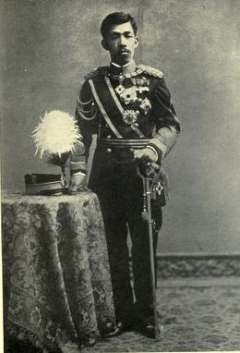 The Emperor Yoshi Hito
 The two events were the bombardment of Kagoshima, the capital city of the great Satsuma fief, by the British fleet in 1863, and the bombardment of Shimonoseki, the stronghold of the equally great Choshiu fief, by the allied fleets of Great Britain, France, the United States and Holland in 1865. The object of the first was to exact reparation for the murder of a British subject; of the second to open to foreign shipping the Straits of Shimonoseki which the ruler of the fief had determined to keep closed. Satsuma and Choshiu were the two most powerful fiefs in the Empire. Both had warmly and enthusiastically adopted the exclusionist policy though from difierent motives, Choshiu being a sincere and wholehearted advocate of it, while Satsuma used it mainly as a means of embarrassing the Tokugawa Government. Both suffered severely, Satsuma in the loss of ships and men, and in the destruction of a great part of the capital - it may be mentioned that the British fleet did not come out of the action scatheless - and Choshiu in the silencing of all the forts on the narrow straits which he had fondly believed to be impregnable, and in the defeat of the flower of his army by the allied forces landed from the fleets after the silencing of the forts. The results were the same in both cases. The feudatories recognised Japan's military impotency against the great Powers of the West, and thinking men learned the great lesson that national unity was essential to national safety, and that one of the first requisites to national unity was the abolition of the dual form of government of Emperor and Shogun.
The lessons learned at such cost by Satsuma and Choshiu were soon imbibed, not only by other great feudatories, but even by some of the Imperial courtiei's at Kioto. They could not however as yet be openly acknowledged. The civil war was still in progress. The Emperor Komei was still obstinate in his old convictions, and the old cry of " Expel the Barbarians " was still the most potent charm for all the enemies of the Shogunate, few of whom were even yet enlightened enough to understand, still less to acknowledge, the new position in which Japan found herself. Two years later, the death of the Emperor removed one great obstacle, and then a far-reaching step was taken by a third feudatory, the lord of Tosa, a fief that was inferior in wealth and strength only to Satsuma and Choshiu. He addressed a memorial to the new Shogun, pointing out Japan's helplessness in the face of foreigners and its own internal disorganisation, urging as the only remedy the complete restoration of the executive authority to the Imperial Government in whom alone it could be legally vested.
The memorial expressed only what was in the Shogun's own thoughts, and urged a course of action which he himself had already seen to be inevitable. On the one side were the Court and the great majority of the feudatories plotting for his fall, many of the latter in arms against him, and all outwardly clamoring for the expulsion of the foreigners. On the other were the diplomatic representatives of the Foreign Powers, pressing him to fulfil the obligations he had undertaken in the treaties, and, in their ignorance of the political conditions of Japan, utterly unable to appreciate or make any allowance for the domestic difficulties which surrounded him. The lessons taught by the bombardments of Kagoshima and Shimonoseki, though the most bitter domestic enemies of his own house had been the sufferers in both cases, had not been wasted on him. He saw that a country divided as Japan was into local principalities, no one of which interested itself in any calamities that might befall its neighbour, among whom there were no common interests, where all patriotism was local and not national, could have no hope of being able to withstand foreign aggression, and he knew enough of the fate of India and of the spoliation of China to be assured that foreign aggression was an imminent danger so long as Japan was helpless to defend herself. No national unity could be attained while the dual system of government continued, and yielding to the teaching of his youth, while he was still a cadet of the house of Mito, in which the doctrine of loyalty to the Emperor had its birth, to the experience of his manhood, and to the high ideal of self-sacrificing patriotism which was the product of both, worn out too by the helplessness of his position and all the heart burnings and humiliations entailed by his inability to coerce his domestic enemies on the one side or to carry out the engagements his Government had made with foreign powers on the other, he resigned his office of Shogun and restored the national executive to its proper source, the Emperor.
By doing so he not only surrendered the supreme executive authority of the Empire, which had been held by his family for 260 years, but ended the dual system of goverinnent, which had lasted from the 12th century. All this occupied little more than one year. It was on the 19th of September, 1866, that the fourteenth Shogun died, and on the 6th of January, 1867, Yoshinobu was nominated his successor. The Emperor Komei died and was succeeded by his only son, Mutsu Hito, on the 3rd of February, 1867, and it was on the 9th of November in the same year that the new Emperor received the Shogun's resignation and assumed in its complete reality the authority which had belonged to his remote ancestois. It was on the day he did so that the foundation stone of modern Japan was laid. Much was yet to be accomplished, more blood was to be shed before Japan entered on the paths of social, political and industrial reform on which she was destined to make such great advances, but the first step had been accomplished and the promoters of the revolution were free to take in the name of the boy Emperor, who had just ascended the throne, such measures as were incumbent to ensure the consolidation and permanency of the new Government.