13. Vices
Some horses are addicted to a very troublesome and vicious habit of turning round suddenly,--we do not here allude to shyness, but restiveness,--without exhibiting any previous symptom of their intention. A horse soon ascertains that the left hand is weaker than the right, and, consequently, less able to oppose him; he, therefore, turns on the off side, and with such force and suddenness, that it is almost impossible, even if the rider be prepared for the attack, to prevent him.
In this case, it would be unwise to make the attempt: the rider would be foiled, and the horse become encouraged, by his success in the struggle, to make similar endeavours to have his own way, or dismount his rider. The better plan is, instead of endeavouring to prevent him from turning, with the left hand, to pull him sharply with the right, until his head has made a complete circle, and he finds, to his astonishment, that he is precisely in the place from which he started.
Should he repeat the turn, on the rider's attempting to urge him on, she should pull him round, on the same side, three or four times, and assist the power of the hand in so doing, by a smart aid of the whip, or the leg. While this is doing, she must take care to preserve her balance, by an inclination of her body to the centre of the circle described by the horse's head.
The same plan may be pursued when a horse endeavours to turn a corner, contrary to the wish of his rider; and, if he be successfully baffled, three or four times, it is most probable that he will not renew his endeavours.
On the same principle, when a horse refuses to advance, and whipping would increase his obstinacy, or make him rear, or bolt away in a different direction, it is advisable to make him walk backward, until he evinces a willingness to advance.
A runaway might, in many instances, be cured of his vice by being suffered to gallop, unchecked, and being urged forward, when he shewed an inclination to abate his speed, rather than by attempting to pull him in: but this remedy is, in most situations, dangerous, even for men; and all other means should be tried before it is resorted to by a lady. Should our fair young reader have the misfortune to be mounted on a runaway, she may avoid evil consequences, if she can contrive to retain her self-possession, and act as we are about to direct. She must endeavour to maintain her seat, at all hazards, and to preserve the best balance, or position of body, to carry her defences into operation. The least symptom of alarm, on her part, will increase the terror or determination of the horse. A dead heavy pull at the bridle will rather aid him, than otherwise, in his speed, and prevent her from having sufficient mastery over his mouth and her own hands to guide him. She must, therefore, hold the reins in such a manner as to keep the horse together when at the height of his pace, and to guide him from running against anything in his course; and, it is most probable that he will soon abate his speed, and gradually subside into a moderate pace. Sawing the mouth (that is, pulling each rein alternately) will frequently bring a horse up, in a few minutes. Slackening the reins for an instant, and then jerking them with force, may also produce a similar effect: but, if the latter mode be adopted, the rider must take care that the horse, by stopping suddenly, do not bring her on his neck, or throw her over his head.
In whatever manner the runaway be stopped, it is advisable for the lady to be on the alert, lest he should become so disunited, by the operation, as to fall.
Our readers may think, perhaps, that this advice, however easy to give, is difficult to follow: we beg leave, however, to tell them, that although it is not so easy as drawing on a glove, or replacing a stray curl, it is much more practicable than they may imagine; though, we trust, they may never have occasion to put it to the proof.
There is another situation, in which it is advisable to force the horse, apparently, to have his own way, in order to baffle his attempts. Restive horses, or even docile animals, when put out of temper, sometimes endeavour to crush their riders' legs against walls, gates, trees, posts, &c. An inexperienced lady, under such circumstances, would strive to pull the horse away; but her exertions would be unavailing: the animal would feel that he could master the opposition, and thus discovering the rider's weakness, turn it to her disadvantage on future occasions. We cannot too often repeat, that, although a rider should not desist until she have subdued her horse, she must never enter into an open, undisguised contest with him. It is useless to attack him on a point which he is resolute in defending: the assault should rather be directed to his weaker side. If he fortify himself in one place, he must proportionately diminish his powers of defence in another. He anticipates and prepares to resist any attempt to overcome him on his strong side; and his astonishment at being attacked on the other, and with success, on account of his weakness in that quarter, goes far to dishearten and subdue him. If he plant himself in a position of resistance against being forced to advance, it is a matter of very little difficulty to make him go back. If he appear to be determined not to go to the right, the rider may, on account of the mode in which he disposes his body and limbs, turn him, with great facility, to the left. If he stand stock-still, and will not move in any direction, his crime may be made his punishment: the rider, in such case, should sit patiently until he shew a disposition to advance, which he probably will in a very short time, when he discovers that she is not annoyed by his standing still. Nothing will subdue a horse so soon as this mode of turning his attacks against himself, and making his defences appear acts of obedience to the rider's inclination. When, therefore, a horse viciously runs on one side towards a wall, pull his head forcibly in the same direction and, if, by the aid of the leg or whip, you can drive his croup out, you may succeed in backing him completely away from it. It is by no means improbable, that when he finds that his rider is inclined to go to the wall as well as himself, he will desist. Should he not, his croup may be so turned, outward, that he cannot do his rider any mischief.
In shying, the same principle may be acted upon, more advantageously, perhaps, than in any other case. Should the lady's horse be alarmed at any object, and, instead of going up to, or passing it, turn round, the rider should manage him as we have recommended in cases where the horse turns, through restiveness. He should then be soothed and encouraged, rather than urged by correction, to approach, or pass, the object that alarms him: to attempt to force him up to it would be ridiculous and dangerous. If the horse swerve from an object, and try to pass it at a brisk rate, it is useless to pull him towards it; for, if you succeed in bringing his head on one side, his croup will be turned outward, and his legs work in an opposite direction. This resistance will increase proportionately to the exertions made by the rider. A horse, in this manner, may fly from imaginary, into real danger; for he cannot see where he is going, nor what he may run against. Pulling in the rein, therefore, on the side from which the horse shies, is improper; it should rather be slackened, and the horse's head turned away from the object which terrifies him. By this mode, a triple advantage is gained: in the first place, the horse's attention is diverted to other things; secondly,--the dreaded object loses half its terror when he finds no intention manifested on the rider's part to force him nearer to it; and, lastly,--he is enabled to see, and, consequently, avoid any danger in front, or on the other side of him.
A horse may be coaxed and encouraged to go up to the object that alarms him; and, if the rider succeed in making him approach it, a beneficial effect will be produced: the horse will discover that his fears were groundless, and be less likely to start again from any similar cause. After the first impulse of terror has subsided, the animal, if properly managed, will even manifest an inclination to approach and examine the object that alarmed him: but, while he is so doing, the rider must be on her guard; for the least movement, or timidity, on her part,--the rustling of a leaf, or the passing of a shadow,--will, in all probability, frighten him again, and he will start round more violently than before. After this, it will be exceedingly difficult to bring him up to the object. Astley, however, whom we have before quoted, says, that should the first trial prove unsuccessful, it must be repeated, until you succeed; adding, that the second attempt should not be made until the horse's fears have subsided, and his confidence returned.
A horse that is rather shy, may, in many cases, be prevented from starting, by the rider turning his head a little away from those objects, which, she knows by experience, are likely to alarm him, as well before she approaches as while she passes them.
A lady, certainly, should not ride a horse addicted to shying, stumbling, rearing, or any other vice: but she ought, nevertheless, to be prepared against the occurrence of either; for, however careful and judicious those persons, by whom her horse is selected, may be, and however long a trial she may have had of his temper and merits, she cannot be sure, when she takes the reins, that she may not have to use her defences against rearing or kicking, or be required to exercise her skill to save herself from the dangers attendant on starting or stumbling, before she dismounts. The quietest horse may exhibit symptoms of vice, even without any apparent cause, after many years of good behaviour; the best-tempered are not immaculate, nor the surest-footed infallible: it is wise, therefore, to be prepared.
Stumbling is not merely unpleasant, but dangerous. To ride a horse that is apt to trip, is like dwelling in a ruin: we cannot be comfortable if we feel that we are unsafe; and, truly, there is no safety on the back of a stumbling nag. The best advice we can offer our reader, as to such an animal, is never to ride him after his demerits are discovered: although the best horse in the world, may, we must confess, make a false step, and even break his knees.
When a horse trips, his head should be raised and supported, by elevating the hand; and the lady should instantly throw herself back, so as to relieve his shoulders from her weight. It is useless to whip a horse after stumbling (as it is, also, after shying); for, it is clear, he would not run the risk of breaking his knees, or his nose, if he could help it. If a horse be constantly punished for stumbling, the moment he has recovered from a false step, he will start forward, flurried and disunited, in fear of the whip, and not only put the rider to inconvenience, but run the risk of a repetition of his mishap, before he regains his self-possession. It being generally the practice,--and a very bad practice it is,--for riders to correct horses after having made a false step, an habitual stumbler may be easily detected. When a horse, that is tolerably safe, makes a false step, he gathers himself up, and is slightly animated for a moment or two only, or goes on as if nothing had happened; but if he be an old offender, he will remember the punishment he has repeatedly received immediately after a stumble, and dash forward in the manner we have described, expecting the usual flagellation for his misfortune.
When a horse evinces any disposition to kick, or rear, the reins should be separated, and held by both hands, in the manner we have described in a previous page. This should also be done when he attempts to run away, grows restive, or shies. The body should also be put in its proper balance for performing the defences: the shoulders should be thrown back, the waist brought forward, and the head well poised on the neck. Every part of the frame must be flexible, but perfectly ready for action.
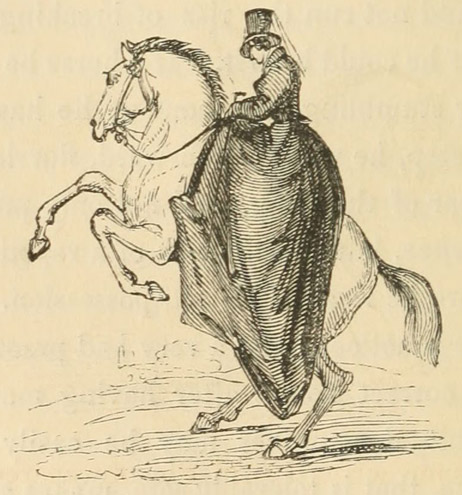
The principal danger attendant on the horse's rearing is, that the rider may fall over the croup, and, perhaps, pull the horse backward upon her. To prevent either of these consequences, immediately that a horse rises, slacken the reins, and bend the body forward, so as to throw its weight on his shoulders; and the moment his fore-feet come to the ground,--having recovered your position, gradually, as he descends,--correct him smartly, if he will bear it; or, endeavour to pull him round two or three times, and thus divert him from his object.
The latter course may also be adopted to prevent his rearing, if the rider should foresee his intention.
A horse that displays any symptoms of kicking, should be held tight in hand. While his head is well kept up, he cannot do much mischief with his heels.
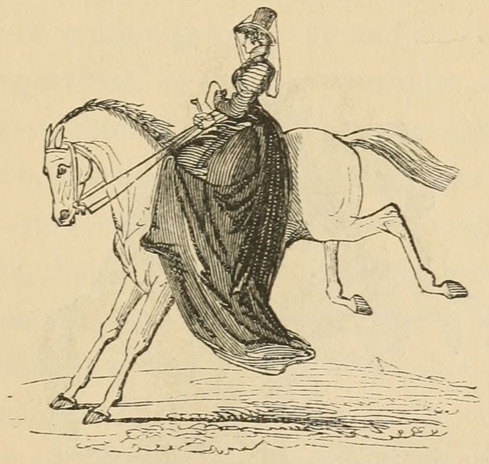
If, however, when the rider is unprepared, in spite of her exertions he should get his head down, she must endeavour, by means of the reins, to prevent the animal from throwing himself; and also, by a proper inclination of her body backward, to save herself from being thrown forward. Should an opportunity occur, she must endeavour to give him two or three sharp turns: this may also be done, with advantage, if she detect any incipient attempts in the animal to kick.
A horse inclined to rear seldom kicks much: but he may do both alternately; and the rider should be prepared against his attempts, by keeping her balance in readiness for either of the opponent defences. She must also take care, that, while she is holding her horse's head up and well in hand to keep him from kicking, she do not cause him to rear, by too great a degree of pressure on his mouth.