9. The Seat And Balance
The body should always be in a situation, as well to preserve the balance, as to maintain the seat.
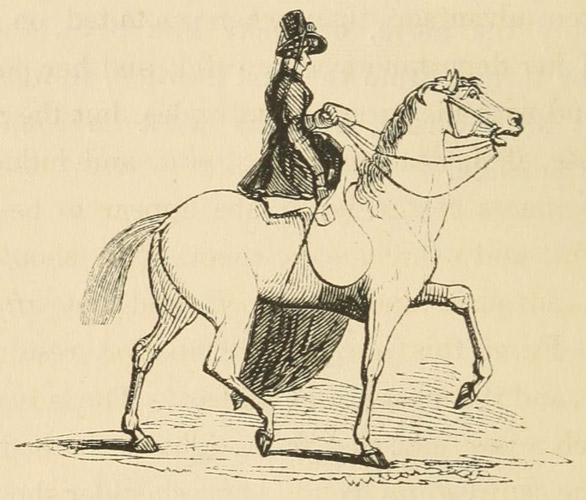
One of the most common errors committed by ladies on horseback, who have not been properly taught to ride is hanging by the near crutch, so that, instead of being gracefully seated in the centre of the saddle, with the head in its proper situation, and the shoulders even, the body is inclined to the left, the head is brought to the right by an inelegant bend of the neck, the right shoulder is elevated, and the left depressed.
To correct or avoid these and similar faults, is important. All the rider's movements should harmonize with the paces of the animal: her position should be at once easy to herself and to her horse; and alike calculated to ensure her own safety and give her a perfect command over the animal. If she sit in a careless, ungraceful manner, the action of her horse will be the reverse of elegant. A lady seldom appears to greater advantage than when mounted on a fine horse, if her deportment be graceful, and her positions correspond with his paces and attitudes; but the reverse is the case, if, instead of acting with, and influencing the movements of the horse, she appear to be tossed to and fro, and overcome by them. She should rise, descend, advance, and stop with, and not after the animal. From this harmony of motion result ease, elegance, and the most brilliant effect. The lady should sit in such a position, that the weight of the body may rest on the centre of the saddle. One shoulder should not be advanced more than the other. Neither must she bear any weight on the stirrup, nor hang by the crutch towards the near side. She ought not to suffer herself to incline forward, but partially backward. If she bend forward, her shoulders will, most probably, be rounded, and her weight thrown too much upon the horse's withers: in addition to these disadvantages, the position will give her an air of timid gaucherie. Leaning a little backward, on the contrary, tends to bring the shoulders in, keeps the weight in its proper bearing, and produces an appearance of graceful confidence.
The head should be in an easy, natural position: that is, neither drooping forward nor thrown back; neither leaning to the right nor to the left. The bust should be elegantly developed, by throwing back the shoulders, advancing the chest, and bending the back part of the waist inward. The elbows should be steady, and kept in an easy, and apparently unconstrained position, near the sides. The lower part of the arm should form a right angle with the upper part, which ought to descend almost perpendicularly from the shoulder. The position of the hands, when both are occupied with the reins, or when the reins are held in one only, we have already noticed: the right arm and hand, in the latter case, may depend, easily, from the shoulder, and the whip be held in the fingers, with the lash downward, between two fingers and the thumb. The whip may also be carried in the right hand, in the manner adopted by gentlemen: the lady is not restricted to any precise rules in this respect, but may vary the position of her whip arm as she may think fit, so that she do not permit it to appear ungraceful. She must, however, take care that the whip be so carried, that its point do not tickle or irritate the flank of the horse.
The stirrup is of very little use except to support the left foot and leg, and to assist the rider to rise in the trot: generally speaking, therefore, as we have already remarked, none of the weight of the body should be thrown upon the stirrup. The left leg must not be cramped up, but assume an easy and comfortable position: it should neither be forced out, so as to render the general appearance ungraceful, and the leg itself fatigued; nor, should it be pressed close to the horse, except when used as an aid; but descend gracefully by his side, without bearing against it.
Although hanging by the left crutch of the saddle, over the near side, is not only inelegant, but objectionable in many important respects, the near crutch, properly used, is a lady's principal dependence on horseback. The right knee being passed over the near crutch, the toes being slightly depressed, and the leg pressed against the fore part of the saddle, the pommel is grasped, and the rider well secured in the possession of her seat. It is said, that when a lady, while her horse is going at a smart trot, can lean over, on the right side, far enough to see the horse's shoe, she may be supposed to have established a correct seat; which, we repeat, she should spare no pains to acquire. In some of the schools, a pupil is often directed to ride without the stirrup, and, with her arms placed behind her, while the master holds the long rein, and urges the horse to various degrees of speed, and in different directions, in order to settle her firmly and gracefully on the saddle,--to convince her that there is security without the stirrup,--and to teach her to accompany, with precision and ease, the various movements of the horse.
Nothing can be more detrimental to the grace of a lady's appearance on horseback, than a bad position: a recent author says, it is a sight that would spoil the finest landscape in the world. What can be much more ridiculous, than the appearance of a female, whose whole frame, through mal-position, seems to be the sport of every movement of the horse? If the lady be not mistress of her seat, and be unable to maintain a proper position of her limbs and body, so soon as her horse starts into a trot, she runs the risk of being tossed about on the saddle, like the Halcyon of the poets in her frail nest,--
"Floating upon the boisterous rude sea."
If the animal should canter, his fair rider's head will be jerked to and fro as "a vexed weathercock;" her drapery will be blown about, instead of falling gracefully around her; and her elbows rise and fall, or, as it were, flap up and down like the pinions of an awkward nestling endeavouring to fly. To avoid such disagreeable similes being applied to her, the young lady, who aspires to be a good rider, should, even from her first lesson in the art, strive to obtain a proper deportment on the saddle. She ought to be correct, without seeming stiff or formal: and easy, without appearing slovenly. The position we have described, subject to occasional variations, will be found, by experience, to be the most natural and graceful mode of sitting a horse:--it is easy to the rider and her steed; and enables the former to govern the actions of the latter so effectually, in all ordinary cases, as to produce that harmony of motion, which is so much and so deservedly admired.
The balance is conducive to the ease, elegance, and security of the rider:--it consists in a foreknowledge of the direction which any given motion of the horse will impart to the body, and a ready adaptation of the whole frame to the proper position, before the animal has completed his change of attitude or action;--it is that disposition of the person, in accordance with the movements of the horse, which prevents it from an undue inclination, forward or backward, to the right or to the left.
By the direction and motion of the horse's legs the balance is governed. If the animal be either standing still, or merely walking straight-forward, the body should be preserved in the simple position which we have directed the lady to assume on taking her seat. Should it be necessary to apply the whip, so as to make the animal quicken his pace, or to pull him in suddenly, the body must be prepared to accommodate itself to the animal's change of action. When going round a corner at a brisk pace, or riding in a circle, the body should lean back rather more than in the walking position: to the same extent that the horse bends inward, must the body lean in that direction. If a horse shy at any object, and either turn completely and suddenly round, or run on one side only, the body should, if possible, keep time with his movements, and adapt itself so as to turn or swerve with him; otherwise, the balance will be lost, and the rider be in danger of falling, on the side from which the animal starts. In no case, let it be remembered, should the rider endeavour to assist herself in preserving her balance, by pulling at the reins.